
A few years ago, “automation” in SaaS meant setting up a welcome email or routing a support ticket to the right inbox. That era is over. The global AI SaaS market stood at $22.21 billion in 2025 and is projected to hit $367.6 billion by 2034, growing at a CAGR of 36.59%. Behind those numbers is a very real behavioural shift across the industry.
SaaS companies are no longer asking whether to adopt AI. They are asking how fast they can go. Machine learning models now predict what a user will do before they do it. Large language models handle support queries, generate documentation, and engage leads in real time.
AI agents run multi-step workflows end to end without anyone giving them a nudge. Predictive analytics have moved from dashboards that describe the past to tools that shape decisions about the future.
What this means in practice is a leaner, sharper kind of SaaS business. One that can scale operations without scaling headcount at the same rate, and respond to customer needs before those needs turn into complaints or cancellations.
This guide walks through all of it including what AI automation actually means for SaaS, why companies are investing heavily in it, the benefits that truly matter, the use cases delivering real results, the tools worth knowing, and what’s coming next. It also highlights how working with an AI Automation Consultant in India can help SaaS businesses identify the right automation opportunities, improve efficiency, and scale operations more effectively.
What is AI Automation for SaaS?
At its core, AI automation for SaaS means using artificial intelligence to handle tasks, workflows, and decisions inside cloud-based software.
Traditional rule-based automation follows a script. If this happens, do that. It works well for predictable, repetitive actions, but breaks down the moment something falls outside the rules.
AI automation is different because it learns. A rule-based system sends a welcome email when someone signs up.
An AI-powered system looks at who that person is, what they clicked before signing up, what their industry is, and where they are in the onboarding funnel, then sends a message tailored specifically to them.
The outcome is not just efficiency. It is a meaningfully better experience.
Why SaaS Businesses Are Investing in AI Automation
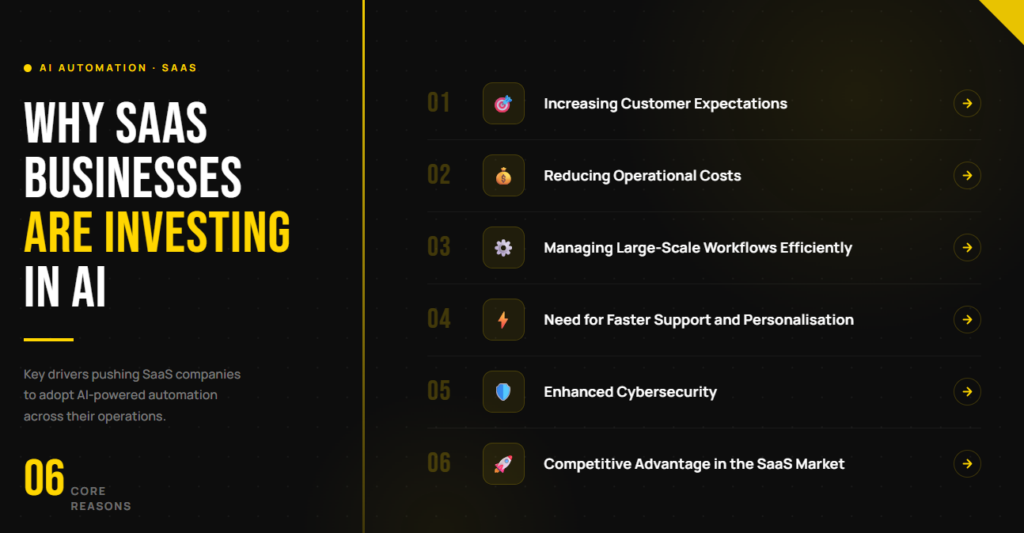
Increasing Customer Expectations
Customer patience has reduced significantly. People using SaaS products today are not willing to wait two hours for a support reply or sit through an onboarding flow that has nothing to do with their actual use case.
They expect speed, relevance, and personalisation, and they expect it from day one. AI helps SaaS teams deliver that at scale.
Automated responses, personalized product journeys, proactive in-app messages based on behaviour, all of this was once only possible with large customer-facing teams.
Reducing Operational Costs
There is a lot of invisible work inside a SaaS business. Ticket classification, usage report generation, invoice creation, data entry, account updates, none of it is glamorous, all of it takes time.
AI handles these functions continuously, at scale, without needing a break or making the kind of errors that creep in when humans are tired or distracted. The savings are real.
Managing Large-Scale Workflows Efficiently
Growth creates complexity. The truth is that a SaaS team of 20 people and 500 customers is vastly different from a team of 80 people and 15,000 customers. Pipelines get longer. The tools are used for distributing account data.
The processes of interdepartmental hand-offs are more complex. AI automation helps with this, by coordinating the work of the systems, providing the right data to the right person at the right time, and ensuring seamless flows even when there is no manual oversight.
Need for Faster Support and Personalisation
Customers aren’t only looking for quick help. They require exactly the right kind of support, in a manner that is sensitive to them. AI enables both. Common queries are answered by intelligent chatbots 24/7.
Ticket routing systems provide the right issues to the right agents right away. Escalation logic ensures cases are escalated or have high risk areas first, before they get queued.
AI can personalize in-app messages, suggestions and follow-up timing according to the usage of each user in regard to personalization.
Enhanced Cybersecurity
Manual detection of security threats is becoming increasingly difficult, particularly for more sensitive data in user accounts handled by SaaS products.
The login behaviour is constantly watched by AI security solutions, which can alert to any suspicious data access and immediately flag irregular activity, even faster than a human security team would. They handle thousands of signals at once, and are on duty around the clock.
Competitive Advantage in the SaaS Market
SaaS is a crowded market. Features get copied quickly, pricing gets slashed, and customer switching costs stay low.
Sustainable differentiation comes from how well you execute, not just what you build. AI automation gives operationally sharp companies an edge that is real and hard to replicate fast.
Faster onboarding, more responsive support, better personalization, and smarter sales workflows all combine into a customer experience that is noticeably better.
Why AI Automation is Important for SaaS Companies
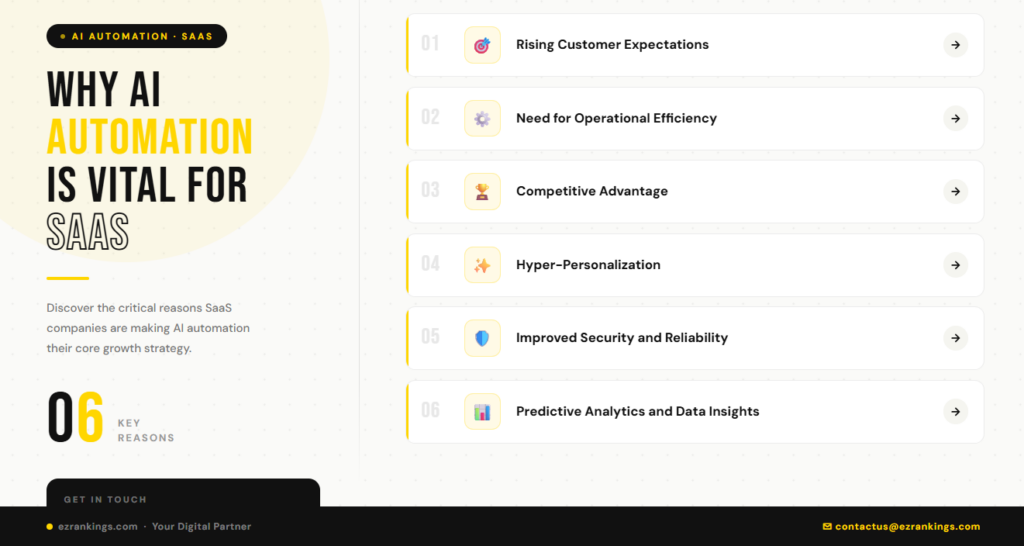
Rising Customer Expectations
The standard customers comparing your product are not your direct competitor. Your real challenge is every great digital experience they have had with other products. That raises the floor for everyone.
AI automation helps SaaS teams keep up without burning out. From contextual support to personalized product flows, it ensures customers consistently feel like the product was built for them specifically. When that impression slips, churn follows.
Need for Operational Efficiency
When growth exceeds capacity, it’s a serious problem. Support queues get longer. Sales follow-ups slip. Onboarding quality drops.
AI automation adds efficiency at every customer touchpoint, doing repetitive, high volume tasks so teams can focus on decisions that do require human judgement.
Companies that incorporate this as part of their business process when it is not yet evident grow with much less friction than those that attempt to work it into the cracks as they appear.
Competitive Advantage
Execution speed is now a genuine competitive differentiator. Companies using AI automation ship faster, respond quicker, and fix problems earlier than those still running on largely manual processes.
That speed compounds. Every month you are automating intelligently and your competitors are not, the gap between your operational efficiency and theirs widens. Catching up later costs significantly more than building the advantage in the first place.
Hyper-Personalization
Personalization of the first name in emails is no longer impressive. They feel that the product should conform to their usage. This is possible at scale with the help of AI.
Feedback that adapts to a user’s behavior, as well as feature suggestions based on usage, custom onboarding routes, and personalized check-ins all help to make the experience feel tailored, not templated.
This personalization will lead to better feature uptake, lower time to value and have a direct, measurable retention benefit.
Improved Security and Reliability
Downtime and data breaches can’t be forgotten by customers of SaaS. One solution to prevent both is to leverage AI automation.
Automated infrastructure monitoring identifies performance problems at a time before users will notice them.
AI security systems are able to detect threats and respond faster than human security systems. Security and reliability may be a buying criteria if large companies are considering SaaS products.
Predictive Analytics and Data Insights
Raw data does not help anyone make better decisions. Processed data does help to make the right calls. These include usage logs, engagement metrics, and financial data that help transform into insights that teams can actually use, with AI automation.
Churn risk scores don’t appear after customers leave. Forecasts for revenue are updated throughout the day. Adoption gaps appear as problems before retention gaps. One of the least obvious benefits of AI for SaaS is the shift from quarterly reporting to intelligent, real-time analytics.
Key Benefits of AI Automation for SaaS
Smarter Customer Support
AI does not just make support faster. It makes it more intelligent. Chatbots handle the repetitive queries that eat up agent time. Routing logic sends complex issues to the right people immediately.
Sentiment analysis flags accounts showing frustration signals before a cancellation request appears. Human agents get to spend their time on the cases that actually need human thinking.
Support quality improves across the board, costs come down, and customers notice the difference.
Customer Retention and Churn Prediction
Acquiring a new customer costs several times more than keeping an existing one. AI automation shifts the retention conversation from reactive to proactive.
Engagement signals, login frequency, feature usage patterns, and NPS trends all feed into churn prediction models that flag at-risk accounts early.
When a customer starts pulling away, an automated workflow can trigger a personalized outreach, a product tip, or a check-in from the customer success team, before that customer starts evaluating alternatives.
Competitive Advantage and Revenue Growth
The financial case for AI automation is straightforward once you look at both sides of the equation. Operational costs go down. Sales efficiency goes up. Marketing reaches better-fit prospects with less manual effort.
Product teams build more relevant features faster. These improvements compound. A SaaS company running leaner, closing deals faster, and retaining customers longer has a structural financial advantage that grows over time.
Smarter Product Development
Product teams often work with incomplete information. Usage analytics are manually checked. Feedback is scattered across tickets, calls, and surveys.
Prioritization decisions get made on gut feel more often than they should. AI automation changes that by surfacing usage data automatically, categorising feedback at scale, and identifying which features are driving retention versus which ones users are quietly ignoring.
When product managers have better information faster, they build things people actually want.
Marketing and Sales Automation
AI has made the revenue side of SaaS significantly more efficient. Lead scoring models surface high-intent prospects before sales reps have to hunt for them.
Email sequences triggered by specific user behaviours land at exactly the right moment. Content personalization serves each visitor a relevant experience based on where they came from and what they are looking at. Sales automation handles CRM updates, follow-up reminders, and meeting scheduling.
Top Use Cases of AI Automation for SaaS Businesses
AI-Powered Customer Onboarding
The first few days inside a SaaS product often determine whether a customer stays long-term. AI-powered onboarding removes the friction from that early period by adapting the setup flow to each user.
A marketing manager and a data analyst using the same tool should not see the same onboarding sequence. AI looks at role, intent, and early behavior to guide users toward their first value moment as directly as possible. When activation is smooth, early churn drops.
Predictive Analytics Dashboards
The old-fashioned idea of reporting was to look back. AI-driven dashboards change that. They extract information from all parts of your product, crunch it automatically and display trends, anomalies and forecasts that you and teams can use to take action instead of waiting to see.
Want results like this for your business?
Talk to our SEO & AI visibility experts — no forms, no waiting.
Get a Free ProposalA product team can detect which features are working well. A customer success team can track and watch churn risk scores throughout their entire book of accounts. A sales team can measure pipeline health by comparing predicted close rates.
AI Sales Assistants
The average SaaS sales rep spends a significant chunk of their week on admin. Logging calls, updating CRM fields, drafting follow-up emails, scheduling demos. AI sales assistants handle all of it automatically.
They score leads based on behavioral signals, suggest optimal follow-up timing, surface relevant case studies for specific deal types, and analyze call recordings to provide coaching feedback. The result is a sales team that spends more time in real conversations and less time doing tasks that do not close deals.
Automated Billing Systems
Billing mistakes can actually hurt more than they sound. If an incorrect invoice or a payment attempt that was unsuccessful, it can cause the customer to cancel.
Subscription management, usage calculations, proration, payment retries, dunning workflows, and fraud detection are all managed by AI-powered billing systems.
They spot anomalies early on, before they impact customers, and help make the financial experience as seamless as the product experience.
AI-Driven CRM Workflows
A CRM is only useful if its data is accurate and its actions are timely. AI-driven CRM workflows handle both. Contact records are enriched automatically.
Deal stages update based on real engagement signals. Follow-up tasks get created the moment a prospect visits a key page or watches a product video.
Customer success teams receive alerts when account health scores drop below a threshold.
Intelligent Knowledge Bases
Most support teams answer the same questions hundreds of times per month. An intelligent knowledge base reduces that volume by making self-service actually work.
AI analyses historical support tickets to identify the most common issues, then ensures the most relevant answers surface before users submit a new ticket.
The knowledge base updates itself as the product changes, pulling in new documentation and flagging outdated articles.
SaaS Workflow Automation
End-to-end workflow automation is where AI really shows its value. An automation with a good structure takes care of updating CRM to the paid plan, of starting the onboarding process, notifying the customer success team, creating the first invoice, setting the next check-in email and will record it in the various tools, without requiring any human intervention.
Previously there were scenarios where the cross functional workflows were dependent on handoffs from three or four teams, and now they are running nicely in the background.
Top AI Automation Tools for SaaS Companies
- Zapier is the go-to for teams that need to connect apps and automate simple workflows without writing code.
- For more sophisticated, enterprise automation with more advanced logic and compliance requirements, Workato supports more.
- At the customer communication layer, Intercom AI and Zendesk AI handle customer support, routing and engagement intelligently.
- Mixpanel and Amplitude are the tools which product and growth teams use to dive deep into the product to find out how the users are really using it.
- With HubSpot AI, you can integrate marketing automation, lead scoring, and CRM all within a single platform.
Agentic AI and the Future of SaaS Automation
Agentic AI is a meaningful step beyond the automation most SaaS companies are running today, and it is worth understanding the difference clearly.
A standard chatbot responds to a single question. An AI agent does something different. It takes a goal, figures out what steps are needed to reach it, executes those steps across multiple systems, handles errors or obstacles along the way, and reports back when the task is complete. No human needs to direct each step.
For practical purposes, an AI agent could detect a customer who has churn signals, then review their usage history to determine why, and customize the retention message.
Then it sends the message at the proper time, adds the result to the CRM, and, if there is a chance of risk, escalates the customer conversation to a customer success manager.
Best Practices for Implementing AI Automation in SaaS
Start with Repetitive Processes
The logical first step is your team’s repetitive work. Categorization of support tickets, assign leads to them, generate the invoice, notify new users, compile usage reports.
These are relatively simple, high-frequency work activities that can benefit from automation because it provides quick, results-oriented improvements.
Starting here builds confidence in the technology and gives your team a clear sense of what is possible before you tackle more complex workflows.
Every successful automation also creates a template. Once your team sees how a billing automation works, it is much easier to design the next one. Build momentum before you build complexity.
Define KPIs Clearly
Automation without measurement is just guesswork with better tools. Before any AI system goes live, decide exactly what you expect it to improve.
Response time. Ticket resolution rate. Onboarding completion rate. Churn rate. Conversion rate. Document the baseline. Track the numbers after deployment. This makes it straightforward to see what is working, catch what is not, and make a convincing case to stakeholders when budget decisions come up.
Teams that skip this step often find themselves running automations that nobody can evaluate, which eventually means nobody can justify them either.
Adopt an MVP Approach
It’s natural to want to automate everything. In reality, it results in scope creep, delays, integration issues, and no one using the workflow.
Build a few well-designed use cases, and get feedback as early as possible. The MVP approach is to test the assumption early, prevent technical problems from escalating, and build something people use before scaling it up.
A lot of the best SaaS automations currently in production begin with a simple, rough-around-the-edges proof of concept that demonstrates its worth, and then expanded into organic growth.
Data Quality First
This is the part of AI implementation that nobody finds exciting, but everyone eventually wishes they had done properly. AI systems are entirely dependent on the quality of the data they operate from.
Incomplete CRM records, inconsistent usage logs, duplicate contacts, and mismatched naming conventions all produce unreliable outputs.
Before you scale any AI automation, audit your data, clean what needs cleaning, standardise your input formats, and set up governance practices to keep things clean going forward.
Teams that skip this stage spend months troubleshooting misfired automations and inaccurate predictions.
API-First Agentic Workflows
For AI automation to function properly across your tech stack, every system needs to communicate cleanly through well-structured APIs.
Building your workflows with an API-first mindset means you are not locked into specific tools, you can swap components without rebuilding everything, and you can connect AI agents across platforms as your architecture evolves.
As agentic AI becomes more central to SaaS operations, with multiple AI systems coordinating across departments in real time, the quality of your API infrastructure will determine how far and how fast you can take automation.
Security and Governance
Every automation layer you add is also a potential vulnerability if it is not managed carefully. AI systems access sensitive customer data, make decisions that affect billing and account access, and operate at a speed that makes errors hard to catch manually.
You need clear policies on what AI systems can access and act on, audit logs for all automated decisions, human review checkpoints for high-stakes workflows, and compliance checks for any tool handling regulated data. None of this should slow automation down.
Future Trends in AI-Powered SaaS
The next phase of AI in SaaS is already moving from theory to production in several areas, and it is worth knowing what is coming.
AI copilots are integrated into SaaS interfaces, providing users with on-demand support without leaving the product. Hyper-personalization is taking email beyond the limits. The interfaces are beginning to evolve, with varying features, layouts and suggestions for each user.
The Saas with voice support is possible and now feasible, allowing teams to access information, edit information, and activate workflows with natural language without having to touch a screen.
No-code AI automation platforms are putting sophisticated workflow-building in the hands of non-technical users, which removes a significant bottleneck from most organisations.
Autonomous SaaS platforms will eventually manage entire business functions with minimal human oversight.
Conclusion
Want to grow your SaaS business with smarter digital marketing? EZ Rankings builds data-driven SEO and content strategies for SaaS companies that are serious about scaling.
In 2026, the businesses getting ahead right now are the ones treating AI as operational infrastructure.
From churn prediction to agentic workflows to personalized onboarding, the tools exist and the business case is solid.
What separates companies that benefit from AI automation from those that do not is mostly execution, starting with the right use cases, measuring what matters, and building on what works. Contact EZ Rankings one of the best digital marketing company in India today.
Frequently Asked Questions
Q1. What is AI automation for SaaS?
In the context of SaaS, AI automation involves leveraging AI technology to automate tasks, processes, and decisions within a cloud-based SaaS application without relying on human input. It can learn from the data, adapt to time and not be bound to a script as traditional automation.
Examples of practical applications are automatic customer support, intelligent onboarding, predictive analytics, billing management, and CRM workflows. The goal is to make sure that SaaS teams are able to scale faster than their teams.
Q2. How does AI improve SaaS operations?
AI enhances SaaS performance by handling repetitive tasks with high volume that do not yield much strategic value and free up time that could otherwise be spent on strategic work. You can have support ticket routing, lead scoring, invoices generated, usage reporting, and customer health monitoring all automatic.
AI goes beyond efficiency by also highlighting insights that humans might not catch, like a potential churn risk, high-intent leads and which features are encouraging retention. Companies that use artificial intelligence in their processes are faster to react, better informed on decision making and spend more time doing the job.
Q3. What are the best AI automation tools for SaaS companies?
Popular automation tools include Zapier, which links applications and automates fundamental workflows; Workato, which offers enterprise automation; Intercom AI and Zendesk AI for customer support and customer engagement; Mixpanel and Amplitude for product analytics and understanding client behaviour; and HubSpot AI for marketing automation and CRM. This will depend on the team and the technology they use and the starting point.
Q4. Can startups implement AI automation in SaaS?
Yes, and as early as possible. There are many AI automation tools with low-cost pricing options for small teams and some don’t require any coding. Zapier, HubSpot, and Intercom are all available to early-stage businesses that don’t have the engineering resources available.
A small number of automations (e.g., the lead scoring workflow or an email sequence for new hires) provide immediate value and help your team learn more about what you can get out of the technology.
Q5. What is Agentic AI in SaaS?
Agentic AI is AI systems which can perform a task without being told or directed by a human, and use multiple tools and/or multiple steps to process it.
A chatbot has only one question programmed into it. An AI agent recognizes the situation, determines what action to take, performs a series of actions on various platforms, deals with unexpected issues, and delivers the results to the user.
In SaaS, it could mean that you have features like self-managed customer retention workflows, self-managed sales follow-ups, and end-to-end processes.
Q6. Is AI automation expensive for SaaS businesses?
The cost will depend on the tools you use and complexity of your workflows. The entry level platforms are very low cost and numerous offer free versions with limited use.
Enterprise-grade solutions are costly, but deal with a lot more complexity. The more important question is, what do you get back? AI automation decreases operating costs, support expenses, retention rates, and streamlines the sales and marketing processes.

Mansi Rana
TEDx speaker and digital marketing expert with 22 years of experience driving business growth through innovation and strategy. Known for leadership rooted in both IQ and EQ, with a focus on ethical marketing and collaboration.
LinkedIn
