
Brand Identity: Meaning, Elements, Importance & How It Shapes Business Growth

Many businesses believe that the brand identity is merely a logo or a colour scheme. That is not true. Design is nothing compared to brand identity. It is the way a business wants people to perceive, experience and recall it. In the current world, companies no longer compete based on products or services. Their competition also goes on perception. Whether people will entrust your brand depends on what they think about your brand.
Brand identity describes the way a brand positions itself to the world. It determines the tone, style and message used everywhere. Everything is branded, whether it is websites or emails or customer support. Good identity will provide uniformity in all platforms. This uniformity generates trust in the long run. It also helps a business in coming out of the pack. Properly executed brand identity makes a great business tool, rather than a design project. In this article, we will explore everything about brand identity.
What Is Brand Identity? (Clear & Practical Definition)
Brand identity refers to the way a business presents itself to the world. It is not accidental. Each piece of detail has its purpose. Brand identity involves what people experience, hear and see whenever they come in contact with a brand. This refers to visuals such as logos and colours. It also includes words, voice and how a brand talks. It includes even the customer service and online behaviour.
A business has the ability to control brand identity. It is a message, style and personality that a brand releases. The perception of the brand is different. This is what customers are thinking and feeling about the brand. Although perception can not be completely controlled by a business, a well-established and robust identity will help in making the right direction.
Brand Identity vs Brand Image vs Brand Reputation
Brand identity, brand image and brand reputation have been confused by many people. They are similar in sound, yet not the same. It is significant that a business understands the distinction.
It is the brand identity that a business generates and manages. It involves the logo, colours, tone of voice, values, as well as messages that the brand opts to convey. This is the perception of the business.
The interpretation of those signals by the customers is referred to as brand image. It is the feeling they have in their heads after reading advertisements, using products, or having a contact with the brand. Brand image can be shaped by a business but cannot be controlled by it.
The development of brand reputation is a long process. It is the general opinion formed through a series of experiences, actions and behaviour. Reputation is a combination of trust, reliability, and consistency through the course of time.
Key Elements That Make Up a Brand Identity
1. Visual Elements
The most apparent aspect of a brand identity is visual elements. They help individuals in identifying a brand within a short time. The beginning point is the logo. It is usually accompanied by alternative variants of websites, packaging, and social media. Colours also play a big role. The distinctive colour scheme provides an understanding of familiarity and sentiment. Typography matters too. The typefaces of a brand must fit its personality and be consistent across the board.
Visual elements must adhere to a single stylish direction. This is all done through layout and design consistency. The brand appears professional and trustworthy when there is similarity between spacing, alignment, and structure across platforms. A brand with strong visual elements is easy to recall and easy to believe.
2. Verbal Elements
Verbal elements define how a brand sounds when it speaks. Brand voice refers to the general personality of the words. It may be genial, assured, relaxed or assertive. Communication tone can vary according to the scenario, though the voice remains constant. Messaging style describes the process of exchanging ideas. There are those brands that maintain a basic message and the ones that center on emotion or narrative.
Brand statements and taglines are the ones that aid in the summary of what the brand means using a few words. They are supposed to be simple and memorable. Verbal items are all over. Consistent language creates familiarity since it is used in websites, emails, and even social posts. People begin to feel related to a brand when they realise how it speaks.
3. Brand Purpose and Values
Brand purpose explains why a brand exists beyond making money. It makes the business meaningful. Values refer to the fundamental beliefs and principles by which decisions and actions are made. They affect the manner in which a brand will treat customers, employees, and partners. Brand purpose and values are what the brand is and what it is not.
This may be honesty, quality, fairness, or innovation. Clarity of values also keeps a brand focused even when there is adversity. They also appeal to people with similar beliefs. Trust is achieved by the communication of purpose and values. Customers would like to associate themselves with a brand that means something. A powerful purpose and values make a brand respected and not merely a brand of purchase.
4. Brand Personality
Brand personality gives a brand human traits. It helps individuals in identifying with the brand as though it was a human being. A brand may be familiar, professional, playful and serious. This character must be manifested in all communication. The personality of the brand is how it acts on the internet, how it reacts to their comments, or how it addresses issues. Words, pictures and tone need to be of the same nature.
Platform consistency matters. A brand must not sound informal on social media and funky on the website. When the personality remains constant, the individuals are aware of what to expect. This creates reassurance and confidence. A brand personality is a powerful brand that makes something reach people in a natural and unforgettable way, and not in an artificial and baffling way.
5. Customer Experience
Customer experience refers to the feeling that individuals experience when engaging with a brand. It begins with interactions on the websites. The first impression is positive due to easy navigation and clear information. Touchpoints of marketing such as ads, emails, and social posts must be connected and beneficial. The tone of customer care is important. Civilized, understandable and respectful feedback creates confidence and trust.
Communication is ongoing even after a purchase. The long-term relationships are influenced by post-purchase messages, follow ups, and support. Each communication conveys a brand message. Customers will feel appreciated when the experience is easy and consistent. Buyers become loyal supporters through a good customer experience. It also reinforces the brand identity by taking actual steps, not words or design.
Why Brand Identity Is Important for Businesses
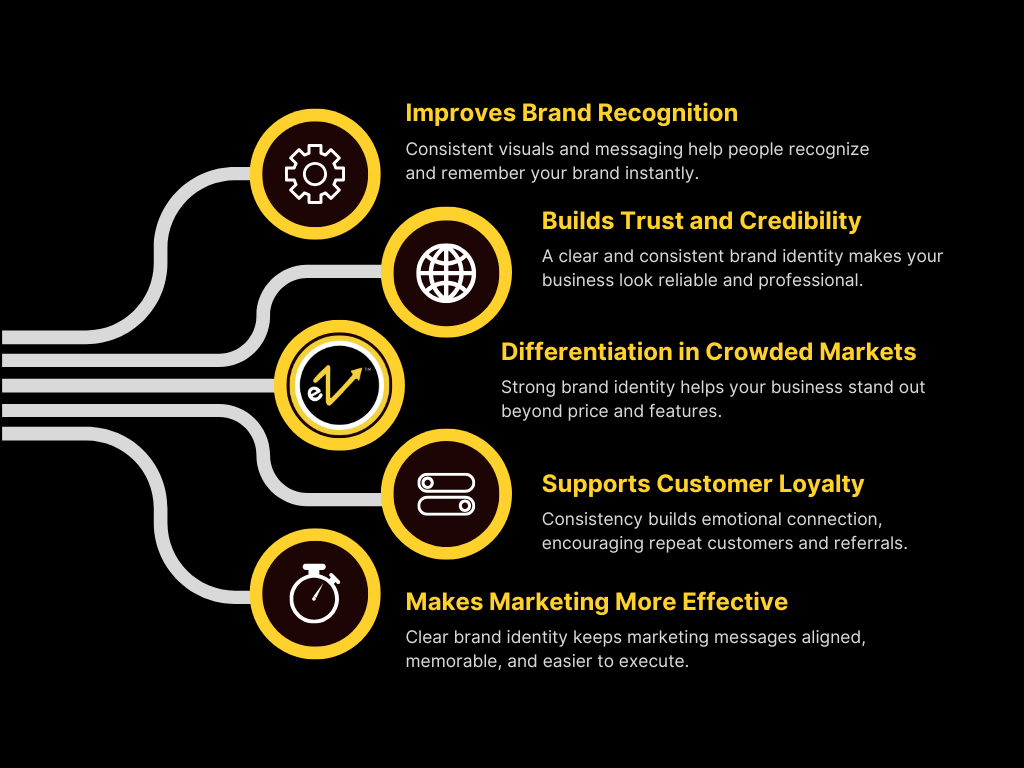
1. Improves Brand Recognition
Brand recognition refers to the ease at which individuals identify a business. This is facilitated by a good brand image. When a brand is consistent in the use of colours, logo, style, and voice used everywhere, then people begin to recall it. In the long run, they are able to identify the brand without looking at the name. This acquaintance is strong. It assists a business to remain on the front burner when customers are willing to purchase. Confusion is also minimized by having a distinct brand image. The individuals are aware of the brand and what it sells. Recognition makes a brand stand out in a busy market. The more they are aware of a brand, the more they will be inclined to trust and settle on it.
2. Builds Trust and Credibility
Every business needs trust. It is largely built on brand identity. Whenever a brand appears and feels professional and reliable, there is consistency in sound and look. Customers feel more at ease purchasing a brand that looks organised and clear. Confidence is also presented by a strong identity. It informs individuals about the business about whom they are and what they represent. This consistency creates credibility with time. Individuals start believing in promises of the brand. They require quality and experience all the time. Trust is encouraged when things are as expected. There are high chances that a reputable brand will capture repetitive customers and a good word of mouth.
3. Creates Differentiation in Crowded Markets
There are numerous markets where there are similar products and services. Brand identity helps in making a business unique. It displays the difference of the brand but not what the brand is selling. A brand can emphasize its distinctiveness through clear communication, images, and personality. This will assist customers to know why they need to adopt a particular brand as opposed to another brand. Price and features are not the only ways of differentiation. Most of the time it is the way that the brand makes one feel. The strong identity forms a compelling presence in the mind of the customer. Customers are confident about their decision when they are able to observe the difference easily.
4. Supports Customer Loyalty
Customer loyalty grows when people feel connected to a brand. This relationship is developed through brand identity. By remaining consistent and honest, the customers can know what to expect of a brand. This brings about comfort and confidence. Customers will over time trust the brand and know it well. They can even be associated with its values or character. This emotional attachment promotes repeat buying. Soft power is also prone to be suggested by the loyal customers to others. Good identity ensures customers revisit the same place even when the competitors are providing the same. Loyalty does not occur in a single instant. It proliferates by way of repeated and positive brand experiences.
5. Makes Marketing More Effective and Consistent
Marketing works better when brand identity is clear. Powerful identity provides a direction to any marketing activity. It also makes messages, visuals, and tone consistent across platforms. Such consistency simplifies campaigns and makes them easier to remember and interpret. It is also time saving because teams do not necessarily have to begin anew every time. An identity makes marketing feel integrated and not disjointed. People interpret the brand quickly when they encounter the same message. Repeat enhances recall and credibility. Marketing is not about shouting. It is regarding being straightforward and known. With brand identity, marketing is more focused, reliable and effective.
How Brand Identity Influences Marketing & Growth
1. Consistent Branding Improves Recall
Consistent branding helps people remember a business more easily. A brand familiarity comes when it uses the same colours, fonts, tone, and style in all channels. This acquaintance enhances remembering. Individuals begin to identify the brand swiftly, even where there is a lot of noise around. In the long run, they will recall the brand without having a clear view of the name. Uniformity also eliminates confusion. Customers are aware of the kind of experience they can get whenever they engage with the brand. This constant reinforcement enhances recall. Good recall is important as customers tend to select a brand that they recall. A strong and consistent brand name makes the business remain at the forefront when customers are about to make a purchase.
2. Strong Identity Supports Premium Positioning
A strong brand identity can support premium positioning. It makes a business look assured, trustworthy, and quality. People are ready to pay more money when a brand appears polished and expresses itself appropriately. Premium brands are all about experience and not features. This experience is determined by brand identity, which is created in terms of visuals, language, and behaviour. It creates anticipations prior to a customer making a purchase. Value is also indicated by clear identity. It shows that the business is interested in details and consistency. This is creating trust and perceived value. There is the tendency of customers to equate good quality with good branding. Consequently, the brand will be able to position itself as a high quality brand in the market.
3. Helps Align Marketing, Sales, and Customer Service
Brand identity creates a shared direction for teams. Sales, customer service and marketing work together in the same direction when they have the brand in their minds. The message and the tone are the same. This provides the customers with a smooth experience. Marketing draws people with promises that are clear. During conversations, Sales carries on with the same story. It is supported by the customer service post purchase. When everyone sails on the same identity, then the customers experience uniformity throughout the chain. The number of mixed messages and misunderstandings has decreased. Coherence enhances efficiency within the company as well. Within teams, decisions are better made when the teams understand how the brand should behave and talk.
4. Makes Campaigns More Cohesive and Scalable
Marketing campaigns can be managed and expanded more easily by brand identity. In cases where the identity is evident, campaigns take a typical pattern and message. This brings together the channels such as social media, advertisements, and emails. Citizens are aware of the relationship between campaigns very fast. Scalability is also supported by strong identity. New campaigns can be developed with more rapidity without compromising on uniformity as a business expands. By repeating what works, teams remain on brand. This saves time and minimizes errors. Integrated campaigns are professional. Branding can be extended in scale without narrowing. Brand identity serves as a compass, ensuring that all campaigns are productive and on track.
Brand Identity Across Digital Channels
Brand identity is especially important for digital-first businesses. Today, the majority of customers engage in online communication with brands prior to making any purchase. This necessitates uniformity in all digital mediums. The branding of the site must be the same colour, fonts, layout and tone as on other platforms. Users would feel comfortable and secure to browse a site once they feel familiar with it.
Another important touch point is social media. The visual style, language, and tone ought to be similar in all social platforms. A brand should use the same voice in posts, comments, and replies. There should also be good alignment in content marketing. The same message, values and purpose should be reflected in the blogs, videos and social content.
Email and advertising messages should also be in the same name. The subject lines, images and the wording must be related to a brand. Clarity in the customers comes when digital channels work together. This uniformity enhances familiarity, fosters confidence and encourages sustained participation.
Conclusion
Brand identity is not just design or graphics. It is the way that a business portrays itself, talks and the way that it creates relationships with individuals. We explored the role of brand identity with respect to visual, language, values, personality, and customer experience. All these are combined to influence the recognition and recall of a brand. We also dived into the distinction among brand identity, brand image, and brand reputation to eliminate the confusion that usually arises.
Good brand identity will assist a business to be different and gain trust as well as remain similar in all mediums. It helps in improved marketing, customer loyalty, and sustained growth. Transparency is essential in the digital sphere and more so in websites, social media, content and messaging. The customers will be connected and confident when all the touchpoints are aligned.
Brand identity is not a single activity. It is a continuous process that increases with the business. When approached clearly and intentionally it is a potent tool that leads to recognition, confidence and long term success.
EZ Rankings can make you shine in competitive markets whether starting afresh, or building on an already existing brand. Contact EZ Rankings, digital marketing agency now and make your brand name a strong business tool.