Not too long ago, getting found online meant one thing: rank on Google. Pick the right keywords, earn some links, write decent content, and the traffic would come. For years, that formula was enough. Then things changed, faster than most people expected.
AI-powered search is no longer a side experiment. It is the main event. ChatGPT reached 900 million weekly active users in February 2026. Perplexity handles around 780 million queries every month.
Google now shows AI-generated summaries above traditional results for roughly 1 in 5 searches.
People are not just typing into Google anymore. They are asking AI assistants, using voice search, and getting their answers without ever clicking a link.
If your content is not visible across those touchpoints, a growing share of your audience will never find you at all. That is the problem Hybrid Engine Optimization, or HEO, was built to solve.
What is Hybrid Engine Optimization (HEO)?
Hybrid Engine Optimization is a search strategy that optimizes content for both ranking-based and answer-based discovery systems at the same time, and is the core discipline behind our Hybrid Engine Optimization Services. It does not choose between traditional SEO and AI optimization. It does both, through one unified approach.
The term was introduced by Jori Ford, Chief Marketing and Product Officer at FoodBoss, at SEO Week 2025 in New York. Her point was straightforward: the industry had created too many acronyms.
AEO (Answer engine Optimization), GEO, LLMO, AIO. Each one was real, but treating them as separate strategies was making things unnecessarily complicated. HEO was her answer to that fragmentation.
In practical terms, HEO means building content that ranks on Google and Bing, gets pulled into featured snippets and voice results, and earns citations from AI tools like ChatGPT, Gemini, and Perplexity, a core part of what modern Enterprise SEO services now cover.
Why Hybrid Engine Optimization (HEO) is Important in 2026
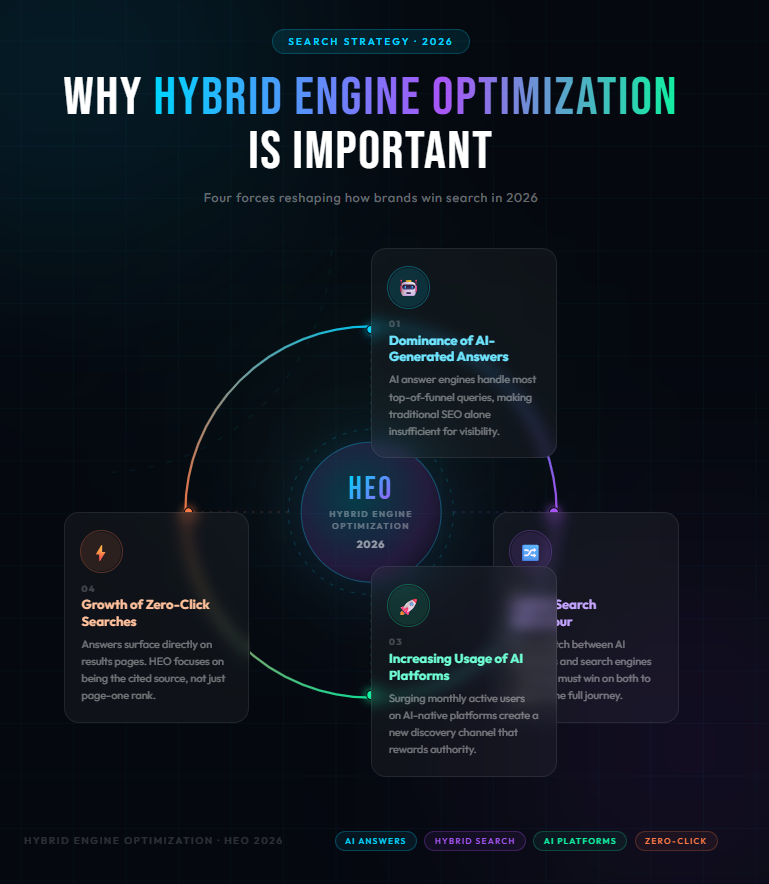
Dominance of AI-Generated Answers
AI-generated answers are not a preview of what is coming. They are already here, sitting at the top of results pages for roughly 20% of all Google searches.
When an AI summary appears, most users read it and stop. They do not scroll. They do not click.
For businesses that spent years earning top organic rankings, this is not a minor inconvenience. It is a structural shift in how visibility works.
HEO (Hybrid Engine Optimization) addresses it directly, optimising content not just to rank below AI summaries but to be the source those summaries draw from.
Hybrid Search Behaviour
Most people do not search in a straight line anymore. A user might type a question into Google, get a partial answer, then take the same query to ChatGPT for more detail, then ask Perplexity to compare options, and then use a voice assistant to get a quick fact while they are away from their screen.
This kind of multi-platform search behaviour is increasingly common, especially among younger, more digitally active users.
A search strategy built around Google alone cannot follow users through that journey. HEO is designed to account for it.
Increasing Usage of AI Platforms
The scale at which people are now using AI search tools is hard to overstate. ChatGPT handles hundreds of millions of conversations weekly.
Gemini is embedded across Google Search and Google Workspace, which means it is already part of how millions of people work every day.
When someone asks ChatGPT which service provider to use, or asks Perplexity to explain a product category, the brands that appear in those answers have an enormous advantage. HEO is what puts a brand in a position to earn that kind of visibility.
Decline of Traditional Blue-Link Search Behaviour
The ten blue links that defined search for two decades are losing their hold on how people interact with results pages.
Featured snippets, People Also Ask sections, AI Overviews, and conversational interfaces have all pulled user attention away from the list of links sitting below them. The way people experience search has changed, even when they are using Google.
Traditional SEO was built around that list of links. Getting to the top of it was the whole game. That game still matters, but it is no longer the only one being played.
Growth of Zero-Click Searches
According to SparkToro Zero-Click Study, only 360 out of every 1,000 Google searches in the US result in a click to a website.
This sounds alarming, but the conclusion it points to is not that SEO is dead. It is that the measure of success needs to change.
Getting cited as the source behind an AI answer, appearing in a featured snippet, having your brand mentioned in a voice result, these are all forms of visibility that HEO captures and that zero-click studies do not account for.
What are the Core Components of Hybrid Engine Optimization (HEO)?
Traditional Search Engine Optimization
Nothing in HEO works without a solid SEO foundation underneath it. Before an AI tool can cite your content, it needs to find it. That means clean technical infrastructure, proper indexing, fast load times, and relevant on-page signals.
Google still processes queries through over 200 ranking signals. Backlinks still matter. Keyword relevance still matters. Page structure still matters.
The difference in HEO is that these fundamentals serve a larger goal. They are not the end state. They are the entry ticket.
Answer Engine Optimization (AEO)
Answer Engine Optimisation is about making your content the go-to response when someone asks a direct question.
That applies to Google featured snippets, voice search results, and the People Also Ask section, but it extends further.
Any platform that delivers direct answers rather than lists of links is an answer engine, and the number of those platforms keeps growing.
The key to AEO is structure. Each section of content should open with a clear, concise answer, ideally under 60 words, before expanding into more detail.
Generative Engine Optimization (GEO)
The goal of GEO (Generative Engine Optimization) is to get your content in the answer, not below it. Generative tools like ChatGPT, Gemini, and Perplexity will determine if a source is worth referencing, based on its depth, credibility, and structure.
Content that the AI can cite often has some common characteristics like named authors with verifiable expertise, original data or research, factual accuracy, full coverage of the topic.
The GEO Industry Report found that companies who went GEO-ready with their content were found up to 10 times more frequently by generative engines than by traditional search engines.
E-E-A-T Signal Reinforcement
Experience, Expertise, Authoritativeness, and Trustworthiness are the signals that tell both Google and AI systems whether your content deserves to be recommended.
Reinforcing E-E-A-T is about consistently demonstrating that the people behind the content know what they are talking about, and that the website publishing it has earned the right to be trusted.
In practice, this is actual real-world authors with genuine credentials and references to other authoritative sources, original ideas that are not available elsewhere, and a proven history of reliable information in the long term.
Semantic and Entity-Based Optimization
Modern search engines and AI understand concepts, not just keywords. They assess the extent to which a piece of content covers the whole context of the topic and not just the word as entered by the user.
Semantic optimization means writing with depth and context, covering a topic thoroughly enough that a search engine or AI tool can map your content to the subject with confidence.
Entity optimization means ensuring your brand and its key offerings are clearly defined across your content, your structured data, and your wider web presence. Together, these practices move content from keyword-optimized to genuinely authoritative.
AI-Readable Structure
AI tools do not read content the way a person does. They parse it. Logical structure, clear headings, short answer blocks, and well-defined sections make it far easier for an AI to extract a useful response from your page.
A well-structured piece of content gives an AI tool exactly the kind of material it needs, that is a clear question, a direct answer, and enough supporting detail to confirm the answer is reliable.
Adding FAQ sections, definition blocks, and how-to sequences in a consistent format improves both traditional SEO performance and AI citation potential.
User Experience and Engagement Signals
AI-driven search systems are paying close attention to how real users behave on a page.
Time on site, scroll depth, and low bounce rates all feed into how algorithms assess whether a piece of content is genuinely useful.
A page that looks technically optimized but fails to hold a reader’s attention will not perform as well as a page that earns genuine engagement.
HEO treats user experience as an optimisation layer, not an afterthought. Content should be easy to read, logically organised, and genuinely valuable.
How Does Hybrid Engine Optimization (HEO) Work?
Understanding Search Intent and Keyword Behaviour
Every effective HEO (Hybrid Engine Optimization) strategy starts with a clear-eyed look at what users actually want when they search.
The keyword is just the surface. Underneath it is an intent, a specific type of answer the user is looking for, whether that is a quick fact, a comparison, a step-by-step guide, or a recommendation.
AI tools are particularly tuned to interpret this intent from conversational, multi-word queries. Research shows that queries of eight or more words are significantly more likely to trigger AI Overviews.
Building Entity and Topic Relevance
A single well-written article does not create authority. A cluster of content that covers a subject comprehensively, consistently, and over time does.
HEO is based on the concept of building content clusters which are sets of related articles and pages, linked together around a common theme and aligned around each other, with their interconnections and shared context driving relevance.
Entity relevance adds another layer to this. Google and AI tools can clearly identify your brand as an authority on a specific subject, because your content, your structured data, and your wider web presence all point to the same area of expertise.
Create Content for Search Crawlers and LLM Training Signals
For content to earn citations from AI tools, it first needs to be found and understood by the bots those tools use to crawl the web.
Tools like GPTBot, ClaudeBot, and PerplexityBot visit websites to assess which content is worth pulling from. Monitoring crawl logs, the server-side records of every bot visit, gives businesses direct insight into which pages AI systems are actively evaluating.
AI bots visit popular pages that are already on their way to be cited. Pages that they ignore need structural changes or authority enhancements. Content with LLM signals involves probing deeper, rather than just superficial research.
Optimize Content for Conversational Queries
Short, fragmented keyword searches are giving way to full questions phrased in natural language.
This is true on Google, and it is even more pronounced on AI platforms where users type or speak the way they actually think. Content that is not structured to address these conversational queries gets left behind.
Optimizing for conversational queries requires problem statements using question-based headers, answers that are relying on context for the question, and considering what questions the user might have following the answer.
Implementing Structured Data and Technical SEO
Structured data tell search engines and AI tools exactly what kind of information a page contains.
FAQ schema, Article schema, HowTo markup, and Organization data all help algorithms understand the purpose and credibility of a page before they even read it in full.
Underneath the structured data layer, the technical foundation has to hold. Page speed, mobile usability, clean crawlability, proper internal linking, and correct indexing all create the conditions under which good content can actually be discovered and rewarded.
Want results like this for your business?
Talk to our SEO & AI visibility experts — no forms, no waiting.
Get a Free ProposalExpanding Visibility Across Multiple Search Platforms
Google is the biggest platform, but it is one of many. A fully-realized HEO strategy accounts for Bing’s AI-powered search, ChatGPT’s web browsing mode, Perplexity’s direct citation model, Gemini’s integration across Google’s product suite, and the voice assistants embedded in smartphones, cars, and smart speakers.
Each platform pulls content in its own way, but the underlying requirement is consistent across all of them. Well-structured, credible, technically accessible content performs on every surface.
The businesses that invest in this kind of content do not need to run separate campaigns for each platform.
What are the Key Benefits of Hybrid Engine Optimization (HEO)?
Increased Visibility in AI Results
The most immediate benefit of HEO is appearing inside AI-generated answers. When ChatGPT or Perplexity cites your content in a response, your brand reaches a user who may never have encountered you through a traditional search result.
According to an analysis, visitors arriving from AI search convert at a rate 23 times higher than those arriving through traditional organic results.
That is not a small difference. It suggests that AI search users arrive with more specific intent and a higher degree of trust in the sources they are referred to.
Multiplatform Presence
Brands that depend entirely on Google rankings are building their entire digital presence on a single point of failure.
HEO distributes that risk by ensuring content can surface across multiple discovery channels at once. Traditional SERP rankings, featured snippets, voice responses, and AI citations all become available pathways to the same audience.
This is not just risk mitigation. It is an opportunity. As user behaviour continues to fragment across platforms and devices, businesses with a consistent presence across all of them maintain their reach.
Improved Brand Authority and Trust
When an AI tool repeatedly cites your content as the source of a reliable answer, it creates a form of brand authority that is very difficult to replicate through traditional marketing.
Users come to associate your brand with credible, trustworthy information on a given subject, even if they never explicitly notice which site is being referenced.
The E-E-A-T signals that HEO reinforces, including named authors, original research, external citations, and experience-driven content, contribute to exactly this kind of authority.
In a crowded content landscape, being the source AI recommends is one of the strongest competitive advantages.
Better Adaptation to AI Search Trends
Search is not going back. AI integration will deepen. New platforms will emerge. Conversational and agent-based search will take on more of the volume that currently flows through text-based interfaces.
Businesses that invest in HEO now are building the infrastructure to stay visible as the landscape shifts further.
The content structures, topical authority, and E-E-A-T foundations that HEO requires are not fragile tactics that need to be rebuilt every time an algorithm updates
They are durable. Brands that build them now will be ahead of the next wave of AI search adoption, rather than scrambling to catch up after it has already reshaped their industry.
Increased Organic Traffic Opportunities
Zero-click growth does not mean traffic disappears entirely. It means traffic moves to new sources.
Brands that are cited in AI responses receive referral visits from platforms like Perplexity and from ChatGPT’s browsing mode.
Featured snippets still drive clicks for high-intent queries. AI Overviews include source links that generate measurable traffic for cited pages.
HEO opens these additional channels without requiring businesses to walk away from existing SEO investment. It builds on what is already working and adds new pathways on top.
Hybrid Engine Optimization vs Traditional SEO
Traditional SEO has always been about ranking on Google. It’s keyword-driven, blue-link-centric and optimized to meet search engine algorithms first. The main goal is to achieve SERP performance.
HEO has a more holistic perspective on ranking the websites. It optimizes for search and AI, and focuses on intent and entities, not keywords.
Beyond the search results, visibility is even reaching into the answers generated by AI and discovery across platforms. Traditional SEO is for the search engine, HEO is for the user journey.
Future of Hybrid Engine Optimization (HEO)
The direction is clear. Google AI Overviews are still expanding. New AI-native search tools continue to launch.
Voice and agent-based interfaces will take on a growing share of queries. In that environment, HEO is not a phase. It is the new baseline.
What makes HEO durable is that it is not built around any single algorithm or platform. It is built around how people actually look for information, which is increasingly conversational, multi-platform, and expectant of direct answers.
Businesses that build toward that goal now will not need to rebuild their strategy every time a new AI feature rolls out. They will already be where it points.
How Businesses Can Prepare for Hybrid Engine Optimization (HEO)
Updating SEO Strategy
The first step is a realistic evaluation of the end of the current strategy. If it’s just about Google ranking, it should do more.
A dual-focused approach is planning content to perform well in traditional search engines from the outset; along with planning for the potential to be cited on AI platforms.
In reality, this involves going beyond just standard keywords and phrases, and incorporating conversational, question-based queries into keyword research, as well as AI referral traffic and brand citations (or mentions) alongside traditional ranking metrics.
Adopt HEO-Friendly Content Structure
Each of the key pages should include a short direct response to the main question at the beginning of each section, then provide supporting information, preferably contained in 60 words or less. Using question-based headings aligns with the way AI tools work best.
Use of schema.org should be maintained throughout the site, such as structured data for FAQ, HowTo and Article. Under every H2, there are short answer blocks that provide an AI tool and featured snippet algorithm with an easy excerpt.
These changes are not that hard to make, but add up to a meaningful impact on the citation potential of AI.
Improving Technical SEO Foundations
It’s no use having great content if your website is technically flawed. Core Web Vitals impact user and bot experience of a page.
As the majority of traffic is from mobile, it is crucial to optimize for mobile usability. You can check crawlability and proper indexing using tools like GPTBot, ClaudeBot, and PerplexityBot.
Internal linking also boosts the relationships between the pages and the authority of the site for the crawlers and AI tools.
With rendering optimization, pages which contain JavaScript should not be blocked for the bot. Moreover, schema markup enhances the machine-readable layer of each page.
Create AI-Readable and Context-Rich Content
Writing for AI readability is not about writing shallowly, but it’s about writing meaningfully and with a level of semantic richness. Ensure that you cover them in enough depth for an AI model to use your site as a resource on the topic.
Establish content clusters, related page links and topical focus. Optimize for named entities, your brand, products, key individuals and places, so that AI systems can categorize your content within specific areas of knowledge.
A short summary section on top of longer content provides a citable summary of the key points for such content, helping generative tools to provide context for the content.
Build Strong Brand and E-E-A-T Signals
AI tools cite sources they trust. Building that trust requires more than a polished website. Every article should carry a named author with clear credentials and a genuine connection to the subject.
External citations from respected industry sources strengthen credibility. Original data, case studies, and experience-driven insights give AI tools the kind of content they prefer over generic summaries that can be found anywhere.
Brand mentions across third-party publications, industry press, and relevant online communities all contribute to the trust signals that both Google and AI systems use to evaluate whether a source is worth recommending.
Optimize for Multi-Platform Search Visibility
Google is the starting point, not the finish line. A serious HEO strategy accounts for Bing, ChatGPT’s web browsing mode, Perplexity’s direct citation model, Gemini’s integration across Google products.
Each platform has its own way of pulling and presenting content, but they share a common preference for content that is credible, well-structured, and technically accessible.
Building one strong, AI-ready content foundation is more efficient and more effective than trying to manage separate campaigns for each platform. The businesses that get this right will have visibility wherever their audience searches.
Monitor Search Behaviour and AI Search Trends
The search landscape is moving fast enough that a strategy set today will need revisiting within months.
Tracking conversational query patterns, monitoring zero-click trends, and measuring AI referral traffic in tools like Google Analytics and Search Console should become regular habits.
Crawl log analysis, reviewing which AI bots visit your site, how often, and which pages they prioritize, provides insight that no third-party tool can replicate.
Watching how AI Overviews evolve, which query types start triggering AI results, and how user behaviour shifts across platforms will directly inform both content and technical decisions.
Conclusion
Ready to Get Ahead of the AI Search Shift? Talk to EZ Rankings, best digital marketing agency and build an Hybrid Engine Optimization strategy that keeps your brand visible on every platform that matters.
Search has shifted, and the shift is not temporary. Traditional SEO built on Google rankings alone is no longer sufficient for businesses that want to stay genuinely visible across the full range of places their audience now searches.
AI tools are mainstream. Conversational search is the norm. Zero-click behaviour is the majority. The old playbook does not cover enough ground. Hybrid Engine Optimization is the framework that does. It’s the right and high time to get started with HEO.
Frequently Asked Questions (FAQs)
Q1. How is HEO different from traditional SEO?
Traditional SEO is built primarily around ranking on Google through keyword targeting, backlinks, and on-page improvements. HEO (Hybrid Engine Optimization) goes further by combining that foundation with Answer Engine Optimization and Generative Engine Optimization. The result is content that performs on traditional search results pages and inside AI-generated answers from platforms like ChatGPT, Gemini, and Perplexity. The ambition shifts from earning a ranking to being the source that AI tools trust and cite, which is a meaningfully different goal.
Q2. Why is HEO important for AI search?
AI search tools do not rank pages the traditional way. They synthesise answers by pulling from sources they consider credible, well-structured, and authoritative. Without HEO, a business might hold strong Google rankings but remain entirely invisible in the AI-generated responses that a growing share of users now relies on. HEO prepares content specifically to meet the criteria these tools apply when deciding which sources to cite.
Q3. Does HEO help with ChatGPT and AI visibility?
Yes, directly. Hybrid Engine Optimization (HEO) improves the likelihood that platforms like ChatGPT, Perplexity, and Gemini will refer your content in their responses. Strong E-E-A-T signals, AI-readable page structure, semantic depth, and genuine topical authority all make a source more attractive to generative AI tools. Monitoring crawl logs for GPTBot and PerplexityBot activity also identifies which pages are already being evaluated by AI systems and which need improvement to qualify for citation.
Q4. What are answer engines in HEO?
Answer Engines Systems are built to provide an answer, instead of a list of links, for a query. They include voice assistants like Siri, Alexa, and Google Assistant, as well as AI tools like ChatGPT, Perplexity, Gemini, and Microsoft Copilot. In a normal search search engine, the answer engines such as Google’s featured snippets and AI Overviews can also be used as answer engines. Structured content is also a critical component of HEO and also Answer Engine Optimization supports it.
Q5. How can businesses optimize for AI-powered search?
Direct and concise answers should go at the beginning of each content section; the best starting points are content structure, technical health and E-E-A-T. Use question-based headings. Apply FAQ, Article and HowTo schema. Make your site fast, mobile and cleanly crawlable. Create topical clusters to show topical expertise. Use named authors that have verifiable credentials. Keep track of AI bot activity in the crawl logs and use analytics to measure the traffic coming in from AI, to see what works.
Q6. Is Hybrid Engine Optimization the future of SEO?
HEO is the natural evolution of SEO in response to how people actually search in 2026. It does not replace traditional SEO. It extends it to cover every major discovery surface that matters today, and most of the ones that will matter tomorrow. As AI becomes more embedded in how users find information, businesses with HEO-ready content will maintain visibility across all platforms.

Mansi Rana
TEDx speaker and digital marketing expert with 22 years of experience driving business growth through innovation and strategy. Known for leadership rooted in both IQ and EQ, with a focus on ethical marketing and collaboration.
LinkedIn