Beyond Google Business Profile: The 2026 Strategy for Ranking in ‘Near Me’ Searches
Someone searches “emergency dentist near me” at 9:45 pm. Another type “AC repair open now” during a heatwave.
Someone looks for a “corporate attorney near me” before signing a contract. These are not casual queries. They are high-intent, moment-of-need decisions where proximity, trust, and availability converge.
Google does not treat these searches as simple keyword variations. Its own documentation states, “Local results are mainly based on relevance, distance, and popularity.”
Google Maps reinforces the same principle: “Local search results in Maps are based primarily on relevance, distance and prominence.”
Notice what is missing. The only criterion is not the closest business. A business that is a bit far might be ranked higher in case it is closer to the query besides having stronger prominence signals.
By 2026, local visibility will require winning near me, i.e. being the most relevant and trustworthy local response in Search and Maps, rather than optimizing a listing.
In this article, we will cover all the things necessary to establish a lasting local authority, starting with entity clarity up to AI readiness.
Why Google Business Profile is baseline, not the strategy
Google Business Profile remains essential. Accurate categories, updated hours, service listings, photos, and active review management are table stakes. Any serious local strategy begins there.
Google’s own documentation makes it clear that visibility is not confined to profile fields alone. Search Central explains the importance of establishing an official presence across systems.
That guidance extends beyond claiming a listing. It includes verifying website ownership in Search Console, managing knowledge panel information where applicable, and implementing structured data to help Google better understand the organization behind the profile.
Equally important, Google states: “There’s no way to request or pay for a better local ranking on Google.”
This is the inflection point. A GBP-only approach eventually plateaus because prominence and entity signals are evaluated across the web, not just inside a profile dashboard.
Links, reputation, structured clarity, and site authority all influence how confident Google feels about a business.
For organizations looking to move beyond surface optimization, explore comprehensive Local SEO Services or integrated SEO Services. To assess your current maturity level, book a Local Authority Stack audit.
How Google ranks local results in 2026
Google has been consistent about the operating model behind local visibility. Its documentation states, “Local results are mainly based on relevance, distance, and popularity.”
Google Maps echoes the same framework: “Several factors, primarily relevance, distance, and prominence, influence the local results.”
These three factors form the backbone of every “near me” result.
Relevance is the degree to which a business fits the query entered by the user. This is service descriptions, web content, type of business and organized data matching.
When your site architecture, on-page language, and profile categories reinforce the same topical focus, Google can more confidently match your business to intent.
Distance considers how far each potential result is from the location term used in a search. In the absence of location specification, Google calculates proximity using location signals. This signal can be enhanced by a clear address information, clear areas of service and well designed multi location page.
Prominence reflects how well-known a business is. Reviews, backlinks, citations, and overall brand recognition contribute to this evaluation. A business that is consistently referenced and positively reviewed builds measurable prominence over time.
Google also makes a critical clarification: “Results in Google Maps are not influenced by payment and moreover, paid content is labelled.”
Local results are not pay-to-play.
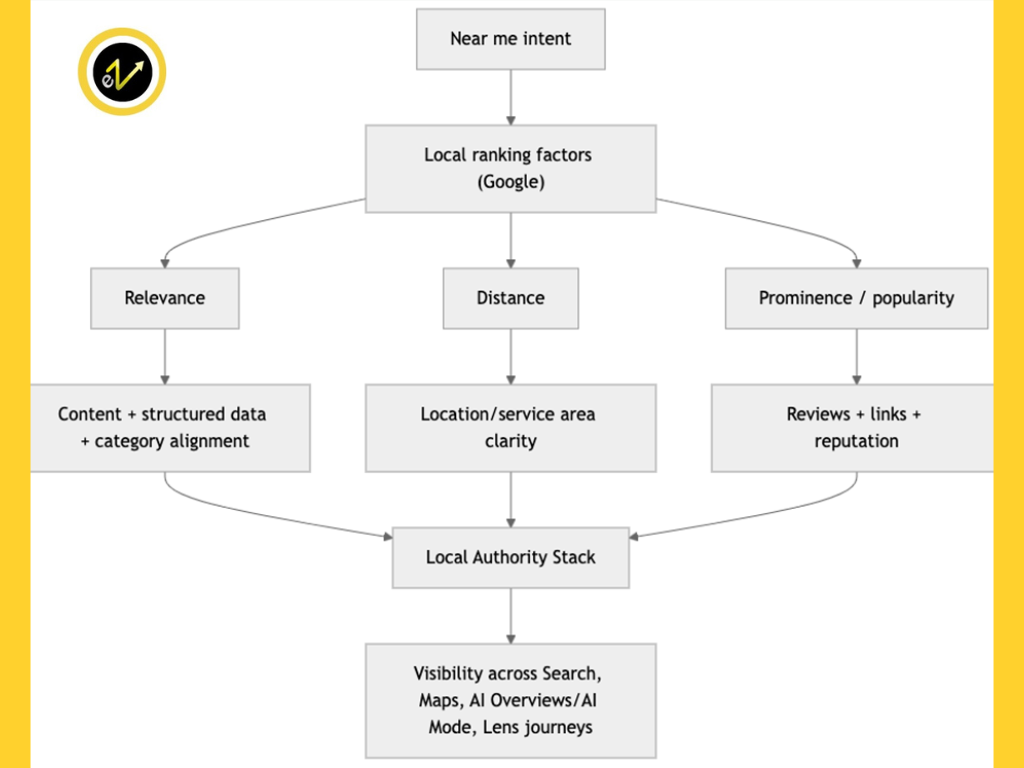
For marketers, the implication is direct. Every tactical decision should map to one of these three levers. Strengthen relevance through site clarity and structured data. Reinforce distance through clean location architecture. Build prominence through reputation and links.
A practical mapping is shown below.
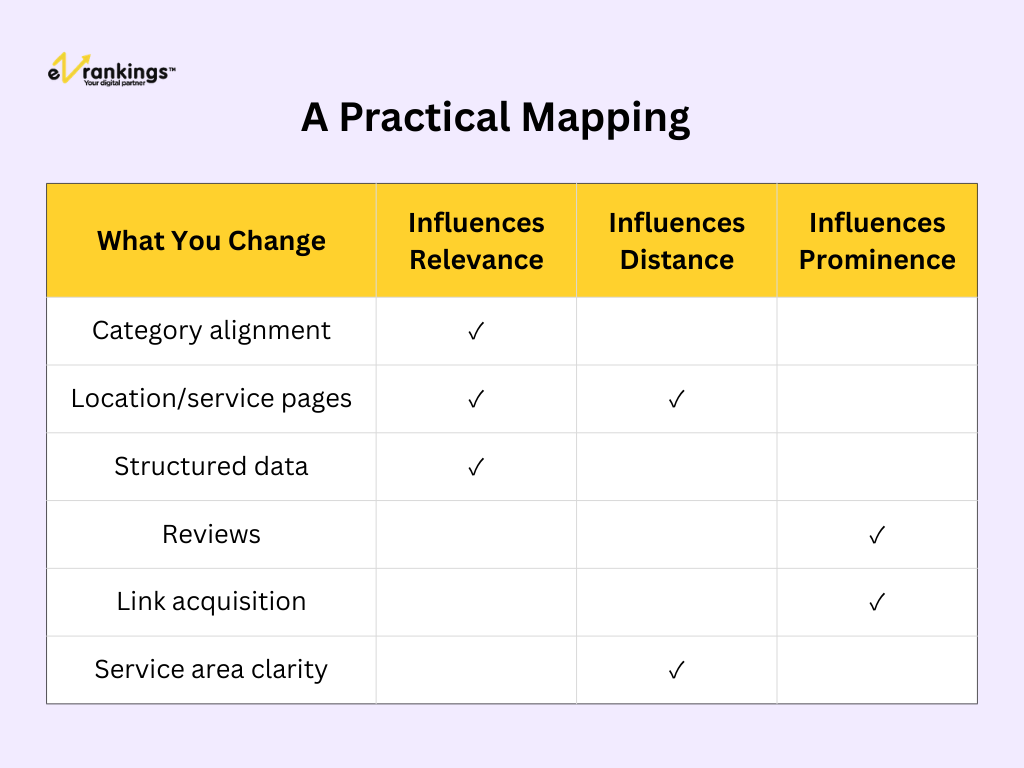
Each subsequent section of this strategy aligns to improving one or more of these factors. If you want to see how this translates into execution tiers, see our local SEO packages.
The Local Authority Stack framework
Local visibility does not improve through scattered tactics. It strengthens when execution aligns with how Google says its systems function. Google explains that it “uses automated ranking systems and it looks at many factors and signals.”
That statement alone removes the idea that one lever, such as profile optimization, determines performance.
Google also makes its philosophy explicit. Ranking systems are “Designed to prioritize helpful, reliable information and not created to manipulate rankings.”
In other words, sustainable visibility comes from building real signals of relevance and trust, not through shortcuts.
Local Authority Stack is based on this principle. It is not a workaround or a technical trick.
It is a designed system that operationalizes what Google publicly assesses, and each level of implementation reinforces quantifiable indicators, rather than pursuing short-term profits.
The framework has five layers.
- First, official presence and entity clarity.
- Second, website-led local relevance architecture.
- Third, prominence is built through reputation, links, and mentions.
- Fourth, page experience and conversion readiness.
- Fifth, AI and multimodal readiness across Search, Maps, and visual journeys.
Each layer reinforces relevance, distance, or prominence. Together, they create systemic local authority. For proof of execution impact, review documented case studies. To evaluate your own maturity level, get a Local Authority Stack audit covering entity, local architecture, and AI readiness. Below is the flow diagram of the local authority near me intent.
Entity and official presence beyond GBP
A Google Business Profile confirms that your business exists in Google’s local ecosystem. Entity clarity goes further. It establishes exactly who you are, which website is official, and how confidently Google can connect your brand across Search, Maps, and knowledge systems. The distinction may appear subtle, but it has measurable ranking implications.
Google’s documentation outlines a clear path. It recommends verifying website ownership in Search Console so you can “understand and monitor how Google displays information” about your site.
Verification is not just administrative access. It strengthens Google’s confidence that your domain and your business profile represent the same entity.
Google also states that adding organization structured data can help Google to disambiguate your organization. Disambiguate means removing duplicate information.
Disambiguation is necessary under the circumstances that there are similar brand names or under the circumstances that more than one business is in the same category. The structured data gives readable signals that are machine readable and minimize uncertainty.
Accuracy is critical. Google cautions, “Don’t add structured data about information that is not visible to the user.” Structured markup must reflect real, on-page content.
Strong entity optimization includes consistent business naming across directories, uniform website references, SameAs links to official profiles where appropriate, organization logo markup, and transparent contact or support details.
The difference is straightforward. GBP is listing data. Entity authority is identity consistency reinforced across the web and through structured data signals. Organization schema is typically implemented on the homepage or About page.
Website-led local relevance architecture
Relevance becomes strong when it is engineered into site architecture rather than added as an afterthought.
Gogle’s guidance on internal linking is direct: “Every page you care about should have a link from at least one other page on your site.” That principle is foundational. If a page cannot be discovered easily through internal pathways, its relevance signal weakens.
Internal links do more than pass authority. Thoughtful anchor text clarifies context for users and helps Google understand the relationship between services, locations, and categories.
A well-linked site communicates hierarchy and intent. Orphaned pages, by contrast, send mixed signals and often struggle to perform.
Scalable structure determines how effectively relevance expands over time. A single-location business may operate with a clean hierarchy where core services connect directly from the homepage.
The multi-location companies have a “/locations/” hub which will branch off to city-level pages which will in turn lead to service offerings pertaining to them. This multi-layered model provides topical depth without sacrificing the navigational clarity.
Different city pages should only be published in case service-area businesses can fill them with meaningful and localized content. Duplication thinly will compromise trust.
Agencies operating nationally can create intersections such as “industries served” and “locations served,” but only when real expertise exists in both dimensions.
URL clarity reinforces architectural intent. Google recommends, “Use descriptive URLs. Make it easy to understand your URL structure.” Descriptive paths like /locations/chicago/corporate-seo/ communicate far more than parameter-driven strings.
Below are the examples of in general good URL structures:
Structured data strengthens this framework. Google explains that search results may display a prominent knowledge panel and that Local Business structured data helps communicate business details. Still, structured data improves eligibility, not guarantees visibility.
Embedding interactive maps on location pages further supports user intent and reduces friction for directions.
For scalable execution, consider a location page blueprint or structured Local SEO Services and Local SEO Packages built around relevance architecture.
Prominence and trust that actually moves the needle
Prominence is not abstract. Google defines it clearly: “Prominence based on info like how many websites link to your business and how many reviews you have.”
In real life, prominence is an indicator of the familiarity and the frequency of reference of a business on the web. This perception of authority is facilitated by link signals, review volume, ratings and third-party mentions.
Trust deepens that signal. Google’s Quality Rater Guidelines state, “The most important member at the center of the E-E-A-T family is Trust.”
Trust is demonstrated on-site through visible proof. Author bios with credentials clarify expertise. Editorial policies signal accountability.
Case studies and transparent methodology show how results were achieved. Legitimacy is enhanced by display of clear contact and customer support information.
Earned reviews should be responded to in a professional manner and presented in an authentic manner. Acquisition strategies that are manipulative undermine long term credibility.
Structured data requires caution. Google states that pages using LocalBusiness or Organization markup “are ineligible for the star review feature” when the entity controls reviews about itself.
Google’s own blog reinforced this change: “Self-serving reviews are no longer displayed for businesses and organizations.”
Prominence grows from earned reputation, not engineered markup.
Case Study Evidences
- Increased local visibility after structured link acquisition
- Measurable review growth and rating improvements
- Conversion lift from enhanced trust signals
For documented outcomes, review our case studies. To strengthen authority systematically, talk to EZ Rankings about reputation strategy, local SEO, and link building services.
Page experience and conversion-ready local UX
Local visibility does not end at rankings. It extends into how users experience the page once they arrive. Google defines Core Web Vitals as metrics that “measure real-world user experience” and states, “We highly recommend good Core Web Vitals” for Search success.
Core Web Vitals evaluate loading performance, interactivity, and visual stability. A slow-loading location page or a layout that shifts unexpectedly during checkout weakens user trust and performance signals alike.
At the same time, Google clarifies that “There is no single signal core ranking system that looks at a variety of signals” aligned with overall page experience.
Page experience is multi-dimensional. Core Web Vitals are part of it, not the entirety.
Mobile performance is especially critical for “near me” journeys. Google confirms, “Google uses the mobile version of a site’s content for indexing and ranking.”
Local consumers with high intent are likely to make fast decisions. The urgency should be reflected on conversion design. Friction is minimized by large click-to-call buttons, clear directions, correct opening hours, and well-defined areas of service.
Confidence is improved by the use of trust badges and open pricing scales where a suitable price is shown. Forms must be brief, quick and simple to fill.
Local intent UX checklist to ensure seamless experience
- Fast loading on mobile
- Stable layout without shifts
- Clear call-to-action above the fold
- Visible contact details
- Embedded directions
- Minimal form fields
Performance across both technical and UX dimensions can be measured using a technical SEO audit and local UX audit or by using structured SEO Services.
AI Overviews, AI Mode, and multimodal discovery
“Near me” journeys no longer end with a traditional list of blue links. They increasingly intersect with AI-generated summaries, expanded answer panels, and visual discovery. The shift is structural, not tactical.
Google states clearly that for AI features there are “No additional requirements nor other special optimizations necessary.” That guidance reinforces an important point. There is no separate AI ranking playbook. Foundational SEO still applies.
Strong content, technical eligibility, crawlability, and entity clarity remain the baseline. What changes is how queries are interpreted and processed.
Google explains that AI systems may use a “query fan-out” technique, issuing multiple related searches across subtopics and data sources. Instead of evaluating a single query string, the system may explore several related angles simultaneously.
This broadens the evaluation surface. Topical depth, consistent branding signals, and clear service coverage increase the probability of inclusion because the system has more contextual paths through which to understand relevance.
From a user perspective, AI Overviews appear as an “AI-generated snapshot with key information and links to dig deeper.” AI Mode goes further and “divides your question into subtopics and searches for each one simultaneously.”
Visual discovery also matters. Users can “Use Google Lens to learn more about an image… objects around you.”
Google confirms that image optimization follows standard guidance. Descriptive alt text, crawlable images, proper indexing, and structured placement remain essential for discoverability across multimodal journeys.
Conclusion
“Near me” performance is not the result of a single optimization. It is the outcome of coordinated execution across systems.
The checklist is straightforward. Establish official presence and entity clarity so Google confidently understands who you are. Build scalable local relevance into your website architecture.
Earn prominence and trust through reputation, links, and visible proof. Enhance the page experience and mobile UX to allow high intent users to take action with ease. Many content ought to be made AI-ready through being structured, comprehensive, and genuinely helpful.
Long-term local visibility comes from disciplined, people-first execution. Book a local strategy call, explore Local SEO Packages, or see documented results in our case studies.