Selling online has changed. Customers want faster responses, personalized experiences, and smooth checkouts, and they will not wait around if they do not get them.
Most ecommerce businesses know this, but keeping up manually is genuinely exhausting. That is where AI automation comes in.
According to reports, the global AI-enabled ecommerce market is on track to cross $64 billion by 2034. Around 77% of ecommerce professionals now use AI daily, and 80% of retail executives expect full AI adoption in the upcoming times.
Businesses using AI for personalization already pull in up to 40% more revenue than those still doing things the old way. If you are running an online store and wondering whether AI automation is worth it, the honest answer is that most of your competitors are already using it and gaining ground every month.
What is AI Automation for Ecommerce?
AI automation for ecommerce is basically about letting smart software handle the tasks your team should not have to do manually. Things like answering the same customer questions all day, updating stock levels, sending follow-up emails, or flagging a dodgy transaction.
These tasks happen constantly, they eat time, and they do not need a human decision every single time. AI learns from your data, picks up on patterns, and handles these tasks automatically. Your team still matters a lot, but they stop drowning in repetitive work.
Also, Check – AI Automation for SaaS: Benefits, Tools & Future Trends
Why Ecommerce Businesses Need AI Automation
Enhanced Customer Experience (CX) & Personalization
AI pays attention to what each person browses, what they buy, what they skip, and uses that to show them relevant products, offers, and content every time they visit.
It is about making a customer feel like your store actually understands what they are looking for. When you get that right, people stay longer, buy more, and come back without needing a discount to do it.
Faster Customer Support with AI Automation
Customers do not really care that your support team works nine to five. If they have an issue at midnight, they want it sorted.
AI-powered chatbots handle the bulk of common queries instantly, whether it is order tracking, returns, or a product question.
In some retail sectors, AI handles 75% of all customer queries, and resolution times have dropped by around 35% for businesses that use it well.
AI Automation for Order Processing
Order processing sounds simple until you are doing it at volume. One mistake in payment verification, one delayed dispatch update, one missed fraud flag, and you have got a complaint on your hands.
AI takes the entire order flow, from confirmation through to customer notification, and handles it without the slip-ups that creep in with manual work.
It checks payments, routes orders to the right warehouse, flags anything suspicious, and keeps customers updated throughout.
Operational Efficiency & Cost Reduction
Behind every online store, there is a pile of admin work that just never goes away. Invoicing, data entry, supplier updates, pulling reports, these things have to happen but they are not where your team’s energy should be going.
AI handles this kind of work faster, more accurately, and without needing a break. Research suggests AI can take over up to 50% of back-office functions in ecommerce, and the businesses that have done this consistently report lower costs and faster turnaround times.
Smarter Inventory & Product Management
Running out of a bestseller the week before peak season is painful. So is sitting on three months of stock that is not moving. Most ecommerce businesses manage inventory reactively, ordering based on gut feel or last month’s numbers.
AI changes that by analysing sales history, seasonal demand, and live market signals to forecast what you actually need and when. AI-driven forecasting cuts supply chain errors by 30% to 50% and reduces warehousing costs.
Improved Marketing, Conversions & Customer Retention
Most ecommerce marketing is reactive. You send a campaign, wait to see what happens, and adjust. AI flips that.
It analyses customer behaviour in real time, predicts who is ready to buy, and triggers the right campaign automatically, whether that is a personalised email, a retargeting ad, or an on-site offer.
Customers who receive relevant communications are far more likely to convert and far less likely to unsubscribe.
AI Search & Visual Discovery
If a customer cannot find what they are looking for within a few seconds, they leave. Most basic search functions just match keywords, which fails the moment someone types something slightly different to how your product is listed.
AI-powered search understands the intent behind a query, handles spelling mistakes, and surfaces relevant results even for vague or conversational searches.
Visual search goes further still, letting shoppers upload a photo and instantly find matching products. Visual searches grew by 70% globally last year.
Benefits of AI Automation for Ecommerce
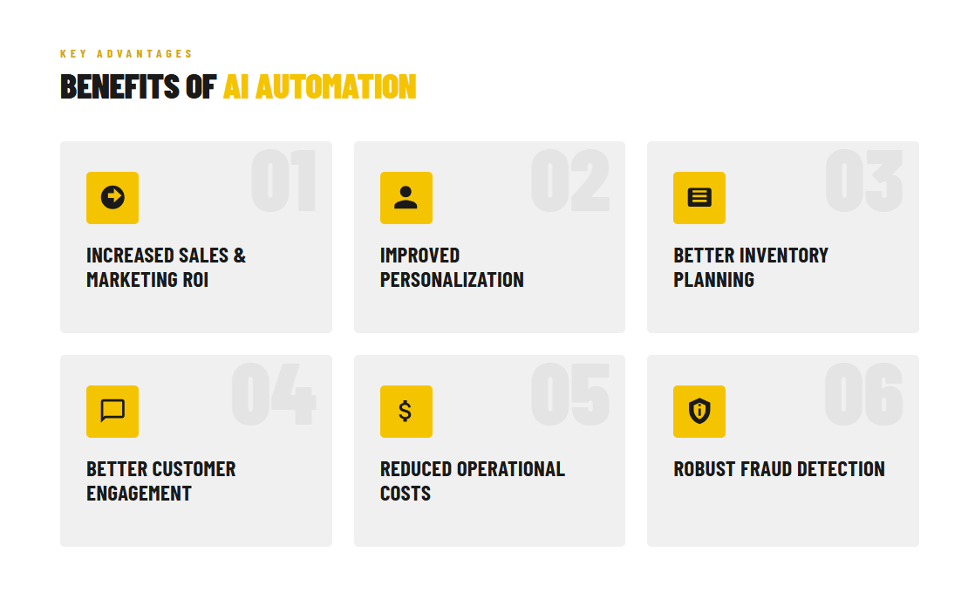
Increased Sales & Marketing ROI
Marketing budgets are tight and every campaign needs to justify itself. AI helps by making sure that budget actually reaches the right people at the right time.
Recommendation engines drive 35% of total ecommerce sales, and businesses using AI personalization bring in up to 40% more revenue than those that do not.
Beyond recommendations, AI tests ad creative, email subject lines, and landing page content automatically, so your campaigns keep improving without constant manual input.
Improved Personalization
Personalisation at any real scale is not possible without AI. You simply cannot manually tailor the experience for thousands of different customers every day.
AI reads individual browsing patterns, purchase history, and real-time behaviour to adjust what each person sees, from homepage recommendations to email content to on-site offers.
Studies show that 91% of consumers are more likely to buy from brands that personalize their experience, and over half say they are likely to come back after a personalized interaction.
Better Inventory Planning
Inventory mistakes are expensive in ways that do not always show up immediately. Overstock locks up capital and inflates storage costs. Stockouts lose you sales and frustrate customers who may not give you a second chance.
AI removes the guesswork by using machine learning to historical data, seasonal trends, and live demand signals to build accurate forecasts.
Slow-moving stock gets flagged before it becomes a problem. The result is an inventory operation that runs leaner, responds faster, and costs less to maintain at every level.
Better Customer Engagement
Customers who feel ignored just stop buying. Keeping them engaged across their entire lifecycle requires consistent, relevant communication, and that is genuinely difficult to sustain manually when you are dealing with thousands of people at different stages.
AI automates the loyalty triggers, personalized follow-ups, smart retargeting, and real-time chat that keeps your brand present without your team having to manage each interaction individually.
Shoppers who interact with AI chat during a session spend around 25% more than those who do not.
Reduced Operational Costs
A lot of what keeps ecommerce businesses expensive to run is not the big strategic work. It is the constant stream of repetitive tasks that take time, create errors, and require people to manage them.
Order routing, stock updates, customer notifications, report generation, all of this can be handled by AI with more speed and fewer mistakes than any manual process.
Research shows 72% of businesses that implement AI report measurable cost reductions, and 75% of retailers that have adopted it have seen operational expenses fall.
Robust Fraud Detection
Ecommerce fraud costs businesses a substantial amount every year, and the methods fraudsters use are constantly changing.
A rule-based fraud detection simply cannot keep pace because it would only be able to detect the frauds that it has been instructed to detect.
AI detection is not the same. It will track all transactions real-time, create a baseline of what “normal” is for your business and alert you to anything that goes against it.
It is constantly updated and improved as new techniques are developed. Suspicious orders are blocked on the spot, without causing friction with legitimate customers.
AI Automation Solutions We Offer for Ecommerce
AI Chatbots & Virtual Agents
Customers ask questions at all hours, and most of those questions are the same ones asked a hundred times a day. This is exactly where our AI chatbot development services come in.
We build and deploy AI chatbots that handle this load across your website, app, and messaging channels around the clock.
Each one is trained on your specific product catalogue, return policies, and brand tone so the answers are accurate and feel right for your business, the exact approach behind our AI Automation for Ecommerce service.
CRM Automation
A CRM full of contacts that nobody is actively managing is not an asset. It is a missed opportunity.
We automate your CRM workflows so that lead scoring, follow-up sequences, lifecycle communications, and contact segmentation all happen based on real customer behaviour rather than waiting for someone to remember to trigger them, the same discipline our CRM Automation Services are built around.
High-intent leads get contacted at the right moment. Loyal customers get acknowledged automatically.
AI-Powered Email Workflows
Email still converts better than most channels in ecommerce, but batch-and-blast campaigns are leaving serious money on the table. We build automated email workflows that respond to real customer behaviour in real time.
Cart abandonment sequences, post-purchase follow-ups, browse-triggered recommendations, and re-engagement flows all fire automatically based on what each person has actually done, an outcome our ecommerce digital marketing agency builds directly into your growth strategy. AI personalizes the content, timing, and frequency for each recipient.
Product Recommendation Setup
Showing customers something they actually want is one of the most direct ways to increase order value. We configure AI recommendation engines that go well beyond the basic “customers also bought” module.
They analyse individual browsing behaviour, purchase history, and product relationships to surface genuinely relevant suggestions across your homepage, product pages, cart, and post-purchase screen.
Industry data shows personalized recommendations can drive a 300% revenue increase and a 150% rise in conversion rates.
Marketing & Personalization Automation
Running consistent, personalized marketing across email, SMS, retargeting, and on-site content manually is simply not sustainable as your customer base grows. We build the infrastructure that makes it happen automatically.
AI segments your audience dynamically, reads purchase intent in real time, and triggers campaigns based on where each person actually is in their buying journey.
Welcome sequences, loyalty offers, win-back campaigns, and promotional pushes all run without a manual launch each time.
Want results like this for your business?
Talk to our SEO & AI visibility experts — no forms, no waiting.
Get a Free ProposalAI Analytics Dashboards
Most ecommerce businesses are sitting on more data than they know what to do with. The problem is not a lack of information. It is that pulling it from multiple sources, making sense of it, and acting on it takes too long.
We build AI-powered analytics dashboards that consolidate your key metrics into a single real-time view and surface the insights that actually matter rather than leaving your team to dig for them.
Ecommerce Workflow Automation
Every manual step in your operation carries risk. Someone forgets. Something gets missed. A delay creates a complaint.
We map your existing processes end to end and automate the steps that should not require human decision-making every single time.
Order management, returns processing, supplier communications, customer notifications, all of it can run reliably on its own without anyone monitoring it constantly.
Once automated, these workflows handle growing volumes without any proportional increase in staffing or oversight.
AI-Powered Customer Segmentation
Sending the same campaign to your entire customer list is one of the easiest ways to waste marketing budget and erode engagement.
We implement AI segmentation that groups your audience based on purchasing behaviour, browsing patterns, lifecycle stage, predicted intent, and more, and updates those segments automatically as behaviour changes.
Campaigns built on accurate, dynamic segments consistently outperform broad sends across every metric.
How Our AI Automation Process Works
Business Analysis
We start by getting a proper understanding of your business before making any recommendations.
It involves looking at what your team does on a daily basis, where the rough spots are, what your customer is going through, and where your current system is stifling you.
We study your technology footprint, review your data and take some time to understand your growth plans for the next 12-24 months.
Workflow Identification
After getting to know your business in depth, we know the processes that are best suited to be automated first.
Sometimes you don’t have to do everything at the same time, and one of the elements that helps you do this correctly is knowing the starting point.
We consider the volume of tasks, the rate of errors, time spent on the task, and the potential consequences of automation in each of these areas.
AI Tool Selection
Choosing the right tools matters as much as choosing the right workflows. We do not have preferred vendors or platform partnerships that influence what we recommend.
Every tool selection is made based on your existing setup, your team’s capacity, your budget, and the specific requirements of each workflow.
We work across a wide range of AI technologies and make recommendations based purely on what will perform best in your environment.
Automation Setup
With workflows defined and tools selected, we move into build and configuration. Our team handles all of the technical complexity, connecting AI tools to your data sources, ecommerce platforms, and customer-facing channels.
Every automation is documented clearly so there is no mystery about how it works or what it does.
We also build in appropriate escalation paths for situations where human input is genuinely needed.
Testing & Optimization
Before any automation touches your live operation, it gets tested properly. We test the workflow in realistic scenarios with edge cases and high volume, and get the logic and gaps right before launch.
The aim is that everything should be working properly from the start and not after customers have been impacted by issues. Using the right AI tools and human expertise, we make sure each aspect is tested well before real customers experience it.
Performance Monitoring
After launch, we stay involved. All automations deployed are measured and reported against the project objectives set up at the beginning of the project.
Performance is monitored on a regular basis; if there is a dip we have a look at this and make changes before it becomes an issue.
With a clear reporting system, your team can always see the impact automation is having on your business.
Why Choose EZ Rankings for AI Automation for Ecommerce
Ecommerce Automation Expertise
We have partnered with ecommerce businesses from all industries and at every growth stage. It means that we approach each project with a true understanding of the reality of online retail, rather than theory alone.
We understand where the pressure points lie, we know what automation really matters and we know what automation looks good but doesn’t really help in the day to day.
AI Implementation Experience
Knowing what AI can do is very different from successfully deploying it in a live business environment.
Our team has hands-on experience implementing AI automation across customer service, marketing, inventory management, order processing, and analytics for real ecommerce businesses.
We know where implementations typically run into trouble, how to prevent it, and how to integrate new tools without disrupting your live operation while it is happening.
Customized Workflows
There is no single automation setup that works well for every ecommerce business, and anything that tries to be one-size-fits-all ends up fitting nobody particularly well.
We build every workflow from scratch based on a detailed understanding of your operation, your customers, and your team’s actual capacity.
This means the automation integrates naturally with how your business already works rather than forcing people to change their processes to fit around a tool.
ROI-Focused Automation
Our team measures success by what your business achieves online, not by how many tools we use. Every automation decision gets evaluated on what it will return, and before anything goes live, we set clear, measurable targets so there is no ambiguity about what success looks like.
After launch, we track performance against those targets and make adjustments where needed. You always have full visibility into what your automation is contributing.
Dedicated Support
Launching your automation is the beginning, not the end of our involvement in your eCommerce business.
After deployment we remain highly involved to ensure your system functions as required and that your team maximises the value of the system that is deployed.
Our support team is prompt, helpful, and takes a proactive approach in identifying problems before they arise, and gives clear answers.
Integration Capabilities
AI automation is only as useful as its ability to work within your existing setup.
We know our way around integrating automation with Shopify, WooCommerce, Magento, BigCommerce, as well as various CRM, email, payment and logistics systems.
We carefully manage the integration of the systems involved, whether your tech stack is relatively simple or made up of multiple interconnected ones.
Conclusion
If you want a clear conversation about where AI automation can make the most difference for your ecommerce business, EZ Rankings, best digital marketing agency India is here. No jargon, no inflated promises. Just a straightforward look at what is possible and what it would take to get there.
The businesses pulling ahead in ecommerce right now are not necessarily the ones with the biggest budgets. They are the ones making smarter decisions about how they operate. AI automation is the infrastructure behind those smarter decisions.
Get in touch with EZ Rankings today and let us work out the right starting point for your business.
FAQs
What is AI automation in ecommerce?
AI automation in ecommerce helps online stores handle repetitive work without manual input. Be it managing customer support chats, product suggestions, order processing, or marketing tasks. Instead of waiting for someone to step in, the system studies customer behaviour and business data in real time, then reacts when needed. This system offers smoother operations, fewer delays, and a better shopping experience for businesses and customers alike.
How does AI improve ecommerce sales?
AI can be incredibly effective in making sales relevant and timely in all aspects of the sales process. Recommendation engines show the right product to the right customer at the right time, boost the average order value and conversion. With personalized marketing, you can get your message to your customers when they’re actually doing what you know they’re doing, and reduce the likelihood of them dropping out and increase retention. With dynamic pricing, you’ll get competitive pricing in real-time. AI also continuously experiments and refines ad targeting, e-mail copywriting and landing pages.
Can AI automate customer support?
Yes, and in most ecommerce businesses, it can deal with a significant amount of queries very well. AI chatbots and virtual agents can handle frequently asked questions like orders, returns, delivery timings, and product information, instantly, regardless of the hour. For more complex and/or sensitive cases, the AI will escalate the case to a human agent and the entire conversation will be stored for future reference and to prevent the customer from repeating themselves.
Which ecommerce platforms support AI automation?
Most ecommerce platforms have features for AI automation or can be integrated with AI automation tools. Shopify comes with a range of AI functionalities and integrates with many automation tools. AI plugins and API-powered integrations for personalisation, chatbots, and stock management are also available on these platforms. AI plugins and API-based integrations also offer personalization, chatbots and inventory management. Of course, AI capabilities are more advanced because they are integrated into the enterprise platforms – Salesforce Commerce Cloud or Adobe Commerce, for example.
Is AI automation suitable for small ecommerce businesses?
It is much more accessible than small business owners think. You don’t need to have a big technology budget or a team of dedicated IT staff to begin with. Email automation, product recommendations, and AI customer support tools are also offered at various price levels, with some being free or having affordable monthly subscriptions. In smaller operations, this return on investment for automation can also be greater since a large amount of time is spent on manual processes.
How much does ecommerce AI automation cost?
Entry-level tools like AI chatbots or email automation workflows can start from a few hundred dollars per month. Mid-range systems that include personalization, integration, CRM automation and analytics will cost more based on order volume and the complexity of the integration. The larger the investment the more custom enterprise implementation would be required. Most companies will pay for automation within the first year and beyond due to the time saved and the minimized error rates and increased conversion.
What are the best AI tools for ecommerce?
For email campaigns and audience segmentation, businesses often turn to Klaviyo and Omnisend. Customer support teams frequently rely on Gorgias and Tidio for AI-powered automation. When personalised shopping experiences matter, Nosto and Dynamic Yield are widely used. Inventory forecasting tools like Brightpearl and Linnworks improve stock management. Big companies often build systems around services from Google Cloud, Amazon Web Services, and Microsoft Azure.
Can AI help reduce cart abandonment?
An Exit Intent tool can be set to display a personalized message or deal to a shopper as they are preparing to leave, which should stop them from going. Email sequences are automated, which allows you to have them send out timely reminders, letting a customer know that they were close to making a purchase. AI can also optimize the checkout experience by offering personalized payment methods and reducing friction at the end to reduce the risk of customer drop-off.

Mansi Rana
TEDx speaker and digital marketing expert with 22 years of experience driving business growth through innovation and strategy. Known for leadership rooted in both IQ and EQ, with a focus on ethical marketing and collaboration.
LinkedIn