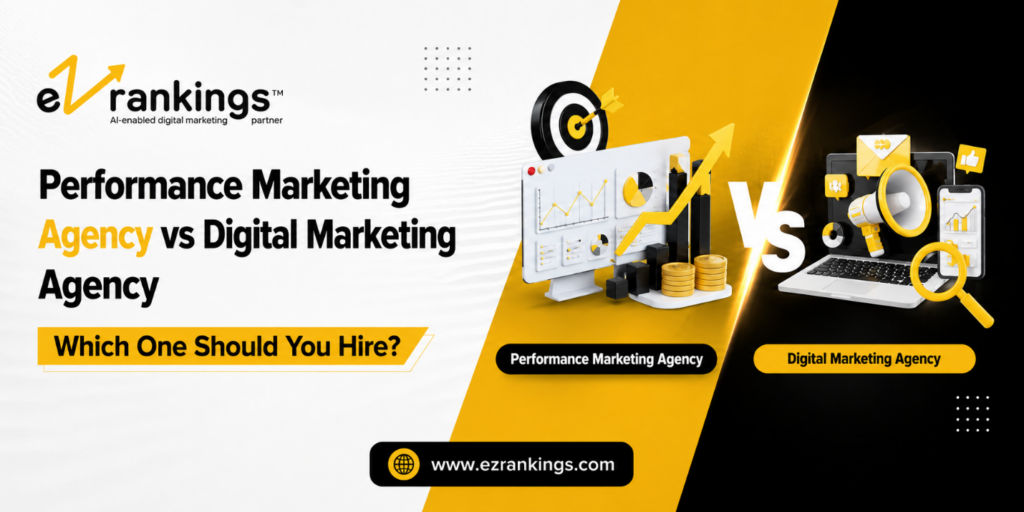
Picking a marketing partner sounds simple until you start comparing agencies. Two labels keep coming up: performance marketing and digital marketing. On the surface they look interchangeable. In practice, they chase different goals, charge in different ways, and measure success by different yardsticks. One is built around immediate, trackable results. The other plays a longer game across several channels. This guide breaks down what each agency actually does, where they overlap, and how to decide which model suits your business right now.
What Is a Performance Marketing Agency?
A performance marketing agency is built around one idea of you pay for results, not activity. Instead of charging for effort or vague brand work, these agencies tie their strategy to actions you can count. That might be a click, a lead, a signup, or a sale. Everything they run gets measured against a target, usually return on ad spend or cost per acquisition.
Most of the work happens through paid channels. The agency buys traffic, tests offers, and adjusts campaigns. If an ad set stops converting, they cut it. If one keeps winning, they scale it. Speed matters here, because paid campaigns give feedback within days rather than months.
You can see exactly what each dollar spent brought back, which makes budgeting easier and results harder to hide. It also suits companies with a defined offer and a clear sales path, since the whole approach depends on tracking a user from first click to final purchase.
The trade-off is that performance marketing usually stops working the moment you stop paying. Traffic and leads are rented, not owned. That is why many businesses use this model to drive short-term revenue while building slower, longer-lasting assets on the side.
How Performance Marketing Works
Performance marketing runs on paid acquisition. The agency buys ads to get your brand in front of people who are ready to act, then steers them toward one specific outcome. None of it is set-and-forget. Campaigns are tuned constantly, with budget moving toward whichever ads, audiences, and placements are actually converting.
Decisions come from the numbers, not emotions. The team tracks CTRs, conversion rates, and cost per result, then adjusts accordingly. Landing pages, headlines, and offers all get reworked to turn more visitors into buyers. And because everything is measurable, you don’t have to guess whether a campaign is working. You’re either hitting the target or you’re not, and when the numbers dip, the approach changes quickly.
Common Performance Marketing Channels
Performance campaigns run wherever your customers spend their attention. Google Ads is often the starting point, since it captures people actively searching for a product or service. Microsoft Ads can add reach in certain markets, especially where an older or business-heavy audience is worth targeting.
Social platforms are where you create demand rather than catch it. Meta Ads work well for both precise targeting and showing off visual products. And if your message is short, YouTube Ads brings video into the mix.
Then, display and retarget ads to visitors who didn’t purchase, reminding them to come back. There is no single formula on this. The best channel blend will vary by your target audience, your business model and the goals you are looking to accomplish with each campaign.
What Is a Digital Marketing Agency?
A digital marketing agency takes a wider view. Rather than focusing on one type of campaign, it manages your whole online presence. Think of it as a full-service partner that handles how your brand shows up in search results, on social media, in inboxes, and on your own website.
The scope is deliberately broad. A full-service agency might improve your search rankings one month, refine your email campaigns the next, and tidy up your website’s technical health along the way. Paid ads often sit inside this offering, but they are one piece of a much larger picture rather than the whole strategy.
This model works for businesses that want steady, compounding growth. Organic channels take time to build, yet they keep delivering long after the initial work is done. A blog post that ranks well can bring in visitors for years without extra spend.
Digital marketing agencies also think about the customer beyond the first sale. They care about reputation, repeat visits, and the assets your brand owns over time. The result is slower to show up on a report, but it tends to be more durable. You are building something you keep rather than renting attention by the day.
Services Typically Offered by a Digital Marketing Agency
A full-service agency usually covers the same core ground, with the emphasis shifting to what your business needs. AI SEO is the backbone: ranking higher on Google & AI Platforms so the right people find you without paying for every click. Content marketing feeds it, the blogs and guides that pull people in and build trust. Social media keeps a real conversation going where your customers already are.
PPC delivers reach faster than SEO can, while local SEO puts you in front of nearby buyers who are searching. Technical SEO keeps the site fast and error-free underneath it all. Email marketing works the audience you’ve earned, CRO converts more of your existing traffic, reputation management guards your image, and analytics keeps every decision tied to real numbers.
How Digital Marketing Supports Long-Term Growth
Digital marketing is incredibly powerful, and that’s reflected in how consistently it works over time. You’ll build more trust with search engines, leading to ever-increasing organic visibility and traffic that isn’t lost once the budget is depleted. It’s the consistency that makes it sustainable. As you go, you gain brand recognition. Useful information and a stellar reputation make first-time guests into repeat visitors. When that trust is established, it makes it easier to acquire new customers and ensures that those that are obtained will be coming back. This is where content assets are at the core. Every guide, page and post you publish works quietly in the background and encourages awareness and retention long after.
Performance Marketing Agency vs Digital Marketing Agency: Key Differences
| Factor | Performance Marketing Agency | Digital Marketing Agency |
| Primary Goal | Measurable acquisition/conversions | Overall digital growth |
| Main Focus | Paid campaigns & performance | Multiple digital channels |
| Time Horizon | Short-to-medium term | Short- and long-term |
| Pricing | Retainer, percentage of ad spend, performance-based models | Usually monthly retainer/project-based |
| Key KPIs | CPA, ROAS, CPL, CAC, conversions | Traffic, rankings, leads, engagement, conversions, revenue |
| Google Ads | Core service | May be included |
| Meta Ads | Core service | May be included |
| SEO | Usually limited/specialised | Often a core service |
| Content | Ad-focused | SEO, educational, brand and conversion content |
| CRO | Strong focus | Often included depending on scope |
| Attribution | Highly important | Important across channels |
| ROI Measurement | Usually direct and campaign-focused | Broader and multi-channel |
This is where the two models truly separate. On paper they share tools and channels, so the overlap can blur the decision. Look closer, though, and they differ in what they optimize for, how long they take to pay off, how they bill you, and how they prove their worth. The sections below explain why each difference matters when you are choosing who to hire, so you can weigh them against your own goals rather than a generic checklist.
Primary Goal and Focus
A performance agency exists to generate measurable acquisitions. Every campaign points at a conversion, and paid channels do the heavy lifting. A digital marketing agency aims wider, treating growth as the sum of many channels working together rather than one paid engine driving sales. That difference in intent shapes almost every decision each agency makes on your behalf, from the tools they reach for to the reports they send you.
Time Horizon
Performance marketing works on a short-to-medium timeline, since paid campaigns produce results almost immediately. Digital marketing spans both horizons. It can run paid ads for quick wins while building organic assets that keep delivering months and years down the line. If you need revenue this quarter, that timeline gap matters a great deal, and it often decides which model fits first.
Pricing
Performance agencies often bill through retainers, a percentage of ad spend, or performance-based models tied to results. Digital marketing agencies usually charge a monthly retainer or work project by project, since much of their value builds gradually across several channels at once. Neither model is cheaper by default; they simply spread cost and risk in different ways, so the right choice depends on how much certainty you want upfront.
KPIs and ROI Measurement
The two models even measure success differently. Performance agencies live by CPA, ROAS, CPL, CAC, and conversions, with attribution tracked tightly at campaign level. Digital agencies watch a broader spread: traffic, rankings, leads, engagement, and revenue across every channel. Their ROI picture is wider and harder to pin to a single ad, which suits businesses thinking beyond the next campaign and towards steady, compounding returns.
Channel and Service Coverage
Google Ads and Meta Ads are core to a performance agency, while SEO tends to be limited or specialized and content stays ad-focused. A digital agency flips that balance. SEO is often central, content covers educational, brand, and conversion needs alike, and paid ads become one option rather than the main event. CRO matters to both, though performance agencies lean on it hardest, since squeezing more conversions from paid traffic is central to how they earn their keep.
Difference in Goals: Immediate Performance vs Long-Term Growth
The clearest way to tell these agencies apart is to look at what they are chasing. Performance marketing is built around immediate outcomes. It goes after leads, sales, and revenue, and it judges every campaign on hard figures like ROAS. The focus stays on customer acquisition at a cost that makes sense, with campaign efficiency treated as the main scorecard. If the numbers dip, the strategy shifts within days rather than weeks.
Digital marketing points at growing broader. Instead of chasing this week’s sales, it builds organic visibility, brand authority, and stronger search rankings over time. Content visibility grows as your pages earn trust, and the whole customer journey gets attention rather than just the final click. The payoff is long-term acquisition that keeps working without constant spend behind it.
It would be a mistake to frame these as rivals. Immediate performance and long-term growth solve different problems, and most healthy businesses need both. Paid campaigns can bring in revenue now while organic efforts build assets you keep for years. Used together, one funds the present while the other secures the future, which is why plenty of companies run both at once rather than picking a side.
Pricing Models: How Are Agencies Paid?
Performance Marketing Agency Pricing
Performance agencies price their work in a few different ways, and the model often reflects how much risk they are willing to share. A monthly retainer is the most straightforward, giving you a fixed fee for a defined set of work. Some agencies instead charge a percentage of your ad spend, so their fee rises and falls with your budget. Some agencies charge on performance, tying the fee directly to results like a cost per lead or a cut of revenue. Plenty land on a hybrid: a base retainer plus a bonus when targets are met. Whichever way it’s structured, read the fine print.
Digital Marketing Agency Pricing
Most digital marketing agencies price around scope, not ad spend. A monthly retainer is the usual setup, covering an agreed set of services each month. For one-off work, project pricing makes more sense, with a fixed fee for something specific like a website rebuild or an SEO audit. Some agencies let you pay per service, so you can take just SEO or just social without buying the whole package. Others roll everything into tiered bundles, which makes budgeting easier when you want several channels handled at once.
What Should You Compare Before Hiring?
Before signing with either type of agency, compare the things that genuinely affect value. Look hard at the scope and the exact deliverables you’ll get each month. Keep ad spend separate from agency fees so you know exactly where your money is going. Check how reporting works, what the contract and exit terms say, and which KPIs the agency is actually willing to commit to. Those details tell you far more than any pitch.
Google Ads and Meta Ads: Which Agency Is Better?
When it comes to paid media, performance marketing agencies usually hold the edge. Running and optimising campaigns is their core craft, so they tend to squeeze more from platforms like Google and Meta than a generalist would.
Want results like this for your business?
Talk to our SEO & AI visibility experts — no forms, no waiting.
Get a Free ProposalGoogle Ads
Google Ads rewards agencies that understand search intent. The best performance teams start by mapping what a searcher actually wants, then match that to precise keyword targeting so your budget reaches ready buyers rather than browsers. For ecommerce, they lean on Shopping and Performance Max campaigns to put products in front of the right shoppers. None of it works without solid conversion tracking, which tells the agency which clicks turn into customers. From there, the real skill shows up in CPA and ROAS optimisation, trimming waste and pushing spend towards whatever converts best.
Meta Ads
Meta Ads call for a different set of instincts. Success here starts with audience targeting, using interests, behaviours, and lookalike groups to reach people who fit your customer profile. Because social feeds are visual, creative testing matters enormously, and good agencies run several versions to find the images and messages that stop the scroll. Retargeting then brings back visitors who showed interest but did not act, often at a lower cost than a fresh click. For many businesses, Meta shines at lead generation, capturing details through simple in-platform forms. For online stores, it drives ecommerce conversions by pairing sharp creative with tight audience data.
Where Digital Marketing Agencies Fit In
Full-service digital agencies are not shut out of paid media. Many manage Google and Meta Ads perfectly well, and some run them to a high standard. The difference is context. Rather than treating paid campaigns as the whole strategy, they fold them into a wider plan that also includes SEO, content, email, and other channels. That means your ads work alongside organic efforts instead of carrying the load alone. For businesses that want everything joined up under one roof, that connected approach can be the bigger draw.
SEO, Content Marketing and Organic Growth
The sharpest line between the two agency models runs between paid and organic. Paid performance buys attention. The moment your budget stops, so does the traffic. Organic digital marketing earns attention instead, building visibility that stays put once the work is done. SEO and content sit at the centre of that organic engine, turning your website into an asset that keeps drawing visitors long after publication. It is slower to show results, but the growth compounds. A page that ranks today can still bring in leads next year, which is something no paid campaign can promise on its own.
Role of SEO
SEO is the foundation needed for organic growth. It is divided into three which collaborate. Technical SEO ensures your site runs quickly, is secure, and search engines can crawl easily. By targeting keywords and planning titles, headings, and copy around what people are actually searching, your on-page SEO will influence your copy. Off page SEO is the process of creating authority backlinks and mentions from other authoritative sites. They collaboratively boost your organic reach and bring the right pages to the forefront for the correct searches. That visibility also extends to AI-powered answers and, in fact, many of the newer search experiences, meaning that strong SEO impacts the way brands are represented in traditional search as well as AI-powered answers.
Role of Content Marketing
Content marketing provides SEO with something to rank. Blog posts address your audience’s questions, and a landing page converts that curiosity into action. Trust is established through thought leadership and educational content helps buyers navigate their choices. All of this translates into the buyer journey, engaging people with it as they progress from curiosity through to decision. It’s not about the frequency of the publishing, it’s about the usefulness of the publishing, every piece pulls someone a step closer to buying.
Why Paid + Organic Can Work Better Together
When it comes to the time frame, paid and organic have different solutions and it’s for this reason that they work well together. Paid campaigns are providing traffic today and this traffic is filling the void of the slower organic traffic. SEO and content then create long-term visibility and authority that reduces your need for ad spend over time. When combined with paid data, an organization can even hone their organic efforts and discover which keywords and messages are performing well. The outcome is a system where the short-term gains pay for the long-term gains, and the long-term gains eventually help to defray the short-term gains.
CRO, Analytics and Attribution
Conversion Rate Optimisation (CRO)
Getting traffic is only half the job. Conversion rate optimization services make sure that traffic actually does something once it arrives. It starts with landing page optimization, shaping layout and messaging so visitors understand the offer within seconds. CTA testing refines the buttons and prompts that ask people to act, while broader user experience work removes the friction that makes them leave. Forms get shortened and simplified, and for online stores, checkout optimization cuts the drop-off that kills sales at the final step. Underpinning all of it is A/B testing, which pits two versions against each other and lets real behaviour, rather than opinion, decide the winner. Small percentage gains here often outweigh spending more on ads.
Analytics and Tracking
Without good measure none of this can be improved. At the heart is GA4, which provides insights into where users are coming from and how they are navigating your website. With Google Tag Manager, you can deploy and manage that tracking without coding that much. Conversion tracking is used to validate which traffic converts to a lead or sale; event tracking is used to track the smaller events that can be recorded, such as video plays or form starts. Funnel analysis then reveals where the people are dropping off, and at which point to intervene. Campaign reporting brings it all together as you’ll get to see which campaigns repaid the investment in your budget! It’s about taking a general idea of what’s working and putting it into tangible proof thanks to good analytics.
Attribution and Measuring ROI
Attribution answers which channel deserves the credit? First-click attribution rewards whatever introduced someone to your brand, while last-click attribution credits the final touch before they convert. Both tell only part of the story. Data-driven attribution spreads the credit across every meaningful interaction, which reflects how buying actually happens across multi-channel journeys. From there, metrics like CAC show what it costs to win a customer, ROAS measures the return on paid spend, and revenue attribution ties results back to real income rather than surface-level clicks.
This is where measurement gets genuinely tricky. When a customer sees a paid ad, later reads a blog post, then converts through an email, no single channel deserves all the credit. Paid and organic constantly influence the same journey, which blurs any clean line between cause and effect.
Which Agency Should You Hire for Your Business?
Startups
Early on, the budget is tight and time is short, so proving demand matters more than building for the long haul. Performance marketing suits this stage well. It brings faster customer acquisition and lets you test whether people actually want what you are selling before you invest further. A small paid campaign can validate an offer in weeks. Once you have signals that the market responds, that is the moment to introduce SEO and content, laying organic foundations that reduce your reliance on ad spend as the business finds its feet.
SMEs
Established small and mid-sized businesses usually need balance, not a single big bet. The goal at this stage is steady lead flow plus visibility that reaches the right people, whether that’s local, national, or both. A blend tends to work best. Paid campaigns keep leads coming in while SEO and content build traffic that gets cheaper over time. If you serve a specific area, local SEO earns its place by pulling in nearby buyers who are already searching. What you’re after is a mix that brings leads without leaving you dependent on ads forever.
D2C & Ecommerce Brands
Online retail lives and dies by paid efficiency and product visibility. Meta Ads drive discovery through sharp creative and precise targeting, while Google Shopping and Performance Max put your products in front of ready buyers. That only works with clean product feed optimization behind it. Retargeting recovers people who left without buying, and CRO lifts the conversion rate on every visit. SEO on category and product pages then adds organic sales that cost nothing per click. Throughout, watch customer acquisition cost against ROAS, since profitable growth depends on keeping that ratio healthy.
B2B Companies
B2B sales take time. Buyers weigh their options, loop in colleagues, and often spend months researching before they ever fill in a form. That changes what good lead generation looks like. Chasing sheer volume gets you nowhere; what you actually want is the small group already looking for a solution, and reaching them starts with targeting search intent rather than casual traffic. Paid campaigns help here too, and LinkedIn can put you in front of decision-makers directly when the audience fits.
Running alongside all that, SEO and thought leadership do the slow work of building credibility, which counts for a lot when someone researches for months before reaching out. It comes down to quality in the end. Ten genuinely qualified enquiries beat a hundred contacts who were never going to buy.
Enterprises
Large organizations need scale and coordination more than any single tactic. That usually means running multiple channels at once, from large-scale SEO across hundreds of pages to paid media that protects and grows brand visibility. At this level, attribution and analytics become essential, since so many touchpoints influence each sale. CRO squeezes more value from significant traffic volumes. What ties it together is an integrated approach, where agency and internal teams work as one rather than in silos. Enterprises rarely benefit from choosing performance or digital marketing; they need both, managed cohesively.
Can You Combine Performance Marketing and Digital Marketing?
You Do Not Have to Choose
Somewhere along the way, this got framed as a decision, as if you had to pick a lane and stick to it. You do not. Most businesses get more from running both than from betting everything on one. Performance marketing handles the immediate, bringing in sales and leads while the budget is live. Digital marketing handles the enduring, building visibility that sticks around once the work is done. Together they cover the whole picture instead of half of it, which is why the strongest growth strategies rarely sit neatly on one side of the line. Now, let’s have a look at how the integrated loop works for your business.
How the Integrated Loop Works
It helps to picture a cycle rather than two separate efforts. Paid acquisition sends immediate traffic to a landing page shaped by CRO, and that page drives conversions. Analytics capture what actually happened, then feed those lessons back into your SEO and content, so organic growth quietly strengthens over time. Retargeting brings back the people who did not convert the first time, and eventually first-time buyers become repeat customers. The paid side generates fast data and revenue; the organic side builds the visibility that keeps the whole system turning without constant spend.
How EZ Rankings Can Support an Integrated Digital Growth Strategy
Combining Performance Marketing With SEO
We see paid and organic as two halves of the same effort. Paid campaigns give us immediate reach and, just as usefully, fast data on which keywords and messages convert. We feed those insights straight into our SEO work, so the pages we build and optimize target what we already know performs. Over time, that organic visibility starts carrying traffic the ads once paid for.
Data-Driven Campaign and Website Optimisation
Guesswork has no place in how we operate. We lean on analytics to understand how people find and use your site, and conversion tracking to see which visits turn into real outcomes. From there, CRO work refines the journey, and landing page optimization removes the friction that quietly costs you conversions. Campaign insights close the loop, telling us what to scale and what to cut.
Building Long-Term Search Visibility
Lasting visibility needs solid foundations, so we begin with the technical side. That means keeping your site fast, clean, and easy for search engines to crawl. From there we build content around the questions your audience is actually typing in, and over time that content earns the authority that pushes rankings up. What we are after is organic performance that holds, the kind that keeps bringing people in long after the work itself is finished. Search is shifting, too. As more answers start coming from AI, we shape content so your brand has a better shot at showing up in both the traditional results and these newer search experiences.
One Integrated Strategy Instead of Isolated Channels
Here is where we tend to differ from a lot of agencies. We do not sell channels one by one. SEO, content, paid media, and CRO all sit inside a single plan built around your goals, because that is exactly where their real strength shows. Split them apart and you leave value on the table. Keep them together and each one makes the others work harder. We would honestly rather hand you one coherent strategy that moves the business forward than a pile of separate tactics you are left to stitch together yourself.
Final Verdict: Performance Marketing or Digital Marketing Agency?
There is no universal right answer here, only the right fit for where your business stands. Choose a performance marketing agency if immediate, measurable acquisition is your priority and you need results you can track from click to sale. Choose a full-service digital marketing agency if you are after broader digital growth, with visibility and authority built across several channels over time. For many businesses, though, the smartest move is an integrated approach that delivers immediate acquisition while quietly building long-term organic growth in the background.
If you are not sure which combination suits you, that is worth a conversation rather than a guess. Talk to EZ Rankings about where your business is heading, and we will help you shape the right mix of services to get there.

Mansi Rana
TEDx speaker and digital marketing expert with 22 years of experience driving business growth through innovation and strategy. Known for leadership rooted in both IQ and EQ, with a focus on ethical marketing and collaboration.
LinkedIn