
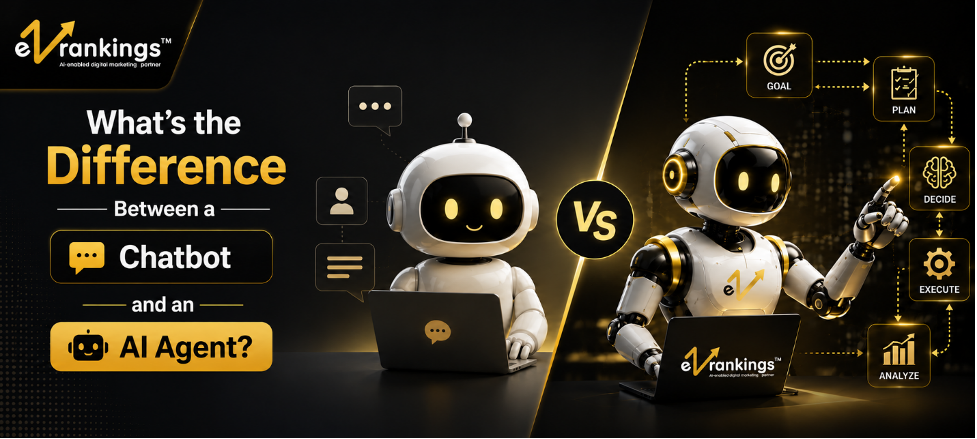
Two years ago, most business automation stopped at “the bot will answer shortly.” Now software resolves the ticket, updates the record, and closes the loop before a person ever looks at it. That jump changed what customer service and daily operations even look like. Gartner expects 40% of enterprise applications to have task-specific AI agents built in by 2026, up from under 5% a year earlier, which tells you how fast this is moving.
Chatbots got us here. They are everywhere now, sitting on websites, tucked into apps, waiting inside your messaging tabs. AI agents are what comes next, and they work in a fundamentally different way. Because both of them chat with users, people file them under the same heading. That is a mistake, and it can cost you when you pick a tool that cannot do what you actually need. So let’s clear it up. What each one is, how it works, where it fits, and how to choose. By the end you’ll know exactly which one your business should be reaching for.
What Is a Chatbot?
A chatbot simulates conversation. Some run on fixed rules and scripted paths. Others use AI to read language more loosely and reply with a bit more substance. The job never really changes though, take a query, return something useful. Where chatbots earn their keep is repetition. When the same questions come in all day, a bot answers them instantly and never tires. FAQs, basic support, appointment booking, early lead capture, all of it fits. Picture a fast responder that handles the routine so your team doesn’t have to.
What Is an AI Agent?
An AI agent chases a goal. You hand it an objective and it figures out how to get there. It starts by understanding what you actually want, not just the words you typed. Then it calculates before it moves, weighing the situation instead of firing off a scripted line. It decides. It remembers, holding onto earlier steps and past conversations. It reaches into other software through APIs to pull data, change records, and set things in motion. And it can run a multi-step job from first instruction to finished result with barely any hand-holding. To simplify, we can say that a chatbot answers, an agent acts.
Why Businesses Often Confuse Chatbots and AI Agents
Honestly, the mix-up makes sense. Both hide behind a chat window, so they look the same at a glance. Both answer questions. Both run on AI, and plenty of today’s chatbots now use large language models, which smudges the line even more. When a bot replies in smooth, human-sounding sentences, people assume there must be something powerful doing the heavy lifting.
Look at what happens next, though. The chatbot answers and it’s finished. An AI agent keeps going. It plans a sequence, runs a whole workflow, and uses outside tools to actually change something. It can dig through data, decide what to do, and complete the task rather than describe it. Answering versus doing. That’s the line.
The Evolution from Chatbots to AI Agents
This didn’t happen overnight. First came rule-based bots, rigid little if-then machines. NLP chatbots followed and learned to catch intent instead of hunting for exact keywords. AI chatbots sharpened that understanding further. Generative AI then made replies genuinely fluent. And now, autonomous agents that reason, plan, and execute. Why the march forward? Because answers stopped being enough. Businesses want systems that finish the work, not ones that just describe how it should be done.
How Chatbots Work
Most chatbots move through a familiar sequence:
- User asks a question: Someone types or speaks their request.
- Intent detection: The bot works out what they’re after.
- Knowledge base lookup: It scans stored content for a match.
- Decision trees: Preset logic steers the reply down the right branch.
- NLP: Language processing helps it make sense of the phrasing.
- Response generation: Out comes the answer, or the next prompt.
Light and quick, which is exactly why it stretches across so many channels. The same engine runs your website chat, your WhatsApp line, Messenger, and live chat. It soaks up the routine volume and passes anything odd to a human. For structured, repeatable exchanges, it’s dependable, and it keeps replies near-instant even when a hundred people show up at once.
How AI Agents Work
An agent’s loop is heavier, because completion asks more than conversation does:
- Receive objective: You give it a goal.
- Understand context: It reads the data, the situation, the limits.
- Break work into steps: The goal splits into smaller ordered tasks.
- Plan: Those steps get sequenced into a strategy.
- Retrieve information: It gathers what it needs from memory or connected sources.
- Use APIs: It calls external tools to move data around.
- Perform actions: It runs each step inside the real systems.
- Verify results: It checks the outcome against the original goal.
- Learn from previous interactions: It banks what worked for next time.
A few things make that possible. Large language models handle the reasoning and the language. Memory keeps context alive from one step to the next. Planning orders the path. Tool calling wires the agent into outside software.
Chatbot vs AI Agent: Comparison Table
| Feature | Chatbot | AI Agent |
| Primary Purpose | Answer questions and hold conversations | Complete goals and execute tasks |
| Intelligence | Rule-based or basic AI responses | Reasoning and contextual understanding |
| Decision Making | Follows predefined flows | Makes independent, context-aware decisions |
| Context Awareness | Limited, mostly single-turn | Deep, across the full task |
| Memory | Session-based and short-term | Long-term and persistent |
| Learning Ability | Static unless manually updated | Improves continuously over time |
| Task Execution | Responds only | Plans and performs actions |
| Tool Integration | Minimal | Broad and native |
| API Usage | Rare or basic | Core to how it operates |
| Multi-step Workflows | Not supported | Fully supported |
| Personalization | Basic and templated | Rich and adaptive |
| Autonomy | Low, needs guidance | High, works independently |
| Scalability | Scales conversations | Scales entire workflows |
| Human Intervention | Frequent for complex cases | Minimal |
| Best Use Cases | FAQs, support, bookings | Sales, operations, research, automation |
Key Differences between Chatbots and AI Agents
Purpose
A chatbot is there to talk. It answers, it guides, it keeps things moving until the user is sorted or handed off to a person. An agent is there to finish something. Processing a refund, updating a CRM, running a research task from top to bottom, whatever the objective happens to be. Dialogue on one side, delivery on the other. That gap in intent quietly shapes everything else, right down to the kind of problems each can realistically take off your plate.
Intelligence
Chatbot’s intelligence is mostly about matching. The bot maps your query to the nearest stored answer, and even the AI-powered ones stay inside that reply-first frame. An agent thinks it through instead. It reads context, sizes up options, and works out a route rather than reaching for a stored line. That reasoning lets it deal with things it has never seen, because it’s problem-solving, not looking up. So the bot performs beautifully on familiar ground, while the agent stays useful when the request is messy or spread across several moving parts.
Decision Making
Ask a chatbot to decide and it follows a flow someone drew in advance. Every input nudges it down a branch on a fixed map, so its “choices” are really just navigation. An agent decides in real time. It reads the current state, factors in what it knows, and picks the next move against the goal. Chat shift halfway through? It adjusts. That’s why agents suit dynamic work where the right call depends on fresh information, and chatbots suit stable processes with clear rules.
Memory
Chatbots mostly live in the session. They’ll recall the last few messages, but once the chat ends, most of that context evaporates. Come back tomorrow and you’re often starting fresh. Agents carry long-term memory. They hold details across sessions, remember decisions they made, and build on earlier work. For real automation that matters, because complex jobs rarely fit inside one short exchange.
Tool Usage
A chatbot’s reach is usually narrow. It might check an order or book a slot, but it doesn’t roam far into your other systems. For an agent, tools are the whole point. It hits APIs, calls external software, shuttles data between platforms. That access is what turns intent into action. The agent can log in, update records, and trigger processes without a human relaying each move. Wider tool access, more of the actual workflow it can own.
Workflow Automation
Chatbots automate the answer. They knock out recurring questions fast and spare your team the repetition, which is worth real money. But they stop at the reply. Agents automate the workflow. They chain steps across multiple tools to finish an entire process. Instead of explaining how to return an item, an agent processes the return, adjusts inventory, and issues the refund. That’s the leap from handling conversations to handling operations, and it’s the part drawing serious attention from teams trying to cut manual work.
Learning Capability
Want results like this for your business?
Talk to our SEO & AI visibility experts — no forms, no waiting.
Get a Free ProposalMost chatbots run on static knowledge. They get sharper only when someone retrains them or rewrites a flow. Leave them alone and they plateau. Agents improve as they go. They learn from outcomes, refine the approach, adapt to new situations, and feed each finished task back into the next one. Give it time and the gap widens hard. Last year’s chatbot performs about the same today, while an agent keeps getting better at your specific processes the longer it runs.
Business Value
A chatbot’s value is support efficiency. Faster replies, higher volume, lower cost on routine service. Solid, measurable, worth having. An agent’s value runs wider. It delivers automation end to end, lifting whole processes off your team across sales, marketing, operations, and support. One sharpens a single function. The other changes how work flows through the company. For anyone chasing growth without piling on headcount, that difference in scope is the reason agents have become a strategic call rather than a nice extra.
Chatbot Use Cases
Chatbots stay a smart pick anywhere conversations repeat in a predictable shape:
- Customer support, resolving common issues at any hour.
- FAQ automation, so the same questions stop eating staff time.
- Appointment booking in a few quick taps.
- Order tracking with status updates on demand.
- Lead qualification, collecting details and filtering early prospects.
- Banking queries like balance checks and routine account questions.
- Ecommerce assistance, nudging shoppers toward products and answers.
- Healthcare inquiries covering appointments and general information.
- Educational support for student and enrollment questions.
The logic is plain. A big chunk of everyday interaction is repetitive, and repetition is precisely where bots shine. They clear that steady volume fast, cheap, and without fatigue, which leaves your people free for the conversations that truly need a human touch.
AI Agent Use Cases
Agents fit wherever a full workflow can be handed off, not just a single question:
- AI customer support agent, resolving tickets end to end.
- AI sales agent, qualifying, following up, keeping the pipeline current.
- AI marketing agent, running campaign tasks across tools.
- Best AI consulting firm often build research agents that gather, analyze, and summarize.
- AI coding assistant, writing, testing, and fixing code.
- AI HR assistant, handling screening, scheduling, and onboarding.
- AI finance assistant, working through data, reports, and reconciliations.
- AI SEO agent, auditing, optimizing, and tracking search performance.
- AI operations agent, coordinating processes across connected systems.
Scope is what sets these apart. Each one automates a complete workflow instead of a single reply. It plans, grabs the right tools, executes, and checks the result. That’s how businesses start removing whole processes rather than shaving minutes off scattered tasks, and it’s where the biggest efficiency gains turn up.
Benefits of Chatbots
The appeal of a chatbot is easy to see. Answers land the moment someone asks, with no queue and no waiting on office hours, since the thing runs day and night. Automating the routine stuff pulls costs out of your support operation. Users stay engaged because someone, or something, always replies. And setup tends to be quick, slotting into channels you already use without much fuss.
Put together, that makes a chatbot a sensible first step into automation. Fast to show results, cheap to run, and easy on your team from day one. If your main need is quick, always-on answers to common questions, a well-built bot often covers it without a big spend or a long rollout.
Benefits of AI Agents
Agents bring a deeper set of wins, because they act instead of only answering. They execute on their own, finishing tasks with minimal oversight, which lifts productivity across the board. They decide intelligently, choosing moves based on context and goal. They personalize, shaping responses and outcomes around the individual user.
They automate full workflows, chaining steps across tools, and in doing so pull repetitive, time-heavy work off your team entirely. The knock-on effect is real efficiency, output climbing without increasing the headcount. And they scale the whole workflows, not just conversations, so the value grows as your operation does.
The Future of Conversational AI
The trajectory is plainly agentic. AI is shifting from systems that talk to systems that do, and the pace is picking up. We’re moving toward autonomous enterprises, where large slices of the operation run on intelligent automation. Multi-agent systems will let several agents coordinate on one complex goal. AI coworkers will sit beside human teams, owning defined tasks instead of assisting from the sidelines. Voice agents will make the whole thing more natural and hands-free.
Hyper-personalization will tune every experience to the person in front of it. And through all of it, human-AI collaboration stays at the center, with people setting direction and agents carrying it out. That’s the case for why agents are on track to become the default for business automation.
Frequently Asked Questions
What is the main difference between a chatbot and an AI agent?
It comes down to action. A chatbot answers questions inside a conversation and stops. An agent takes a goal, reasons through it, plans the steps, uses external tools, and finishes the task with little human help. The bot replies. The agent delivers. That shift from responding to executing is the whole thing, and it decides how much of a real process either one can genuinely automate for you.
Can an AI chatbot become an AI agent?
Not on its own. Bolting on a large language model makes a bot sound smarter, but it still just answers unless you add the missing machinery. To turn into an agent, it needs reasoning, memory, planning, and tool access — the foundation of custom AI agent development services— so it can act rather than talk. Plenty of businesses do evolve a chatbot into an agent over time by layering those in.
Are AI agents replacing chatbots?
Not really. Chatbots still handle high-volume, repetitive conversations extremely well, and that need isn’t disappearing. Agents suit the complex, multi-step work that needs decisions and actions. In practice, a lot of businesses run both; chatbots for quick support, agents for full automation. Think expansion, not replacement. Agents cover ground bots were never built for, while bots keep doing the routine job they already do cheaply and well.
Which is better for customer support?
Depends how deep the support goes. For fast answers to common questions, a chatbot is efficient, affordable, and quick to launch. For support that means resolving issues across systems, like processing returns or updating accounts, an agent handles the whole process end to end. Many teams pair them, letting the bot field simple queries and the agent take anything that needs real action. It really hinges on how complex your typical requests are.
Can AI agents make decisions independently?
Yes, inside the boundaries you set. An agent reads context, weighs options, and picks the next action against the goal rather than a script, adjusting when conditions change mid-task. But it works within the permissions you give it, so independence doesn’t mean unchecked. You stay in control of what it’s allowed to touch, while it handles the moment-to-moment calls needed to reach the outcome you asked for.
Can AI agents integrate with CRM and ERP systems?
Yes, and it’s one of their strongest cards. Agents connect through APIs to platforms like CRM and ERP, reading and updating records, triggering processes, moving data between tools. That integration is what turns a talker into a doer. An agent can update a deal in your CRM or push an entry into your ERP as part of a larger workflow, stitching your systems together and killing the manual handoffs that usually drag those processes down.
Which industries benefit most from AI agents?
The ones with complex, repeatable workflows see the biggest returns. Ecommerce, finance, healthcare, real estate, SaaS, marketing, all run processes an agent can automate end to end. Sales and support teams in nearly any sector benefit too, since agents cover follow-ups, ticket resolution, and data updates at scale. The rule of thumb is that the more multi-step, tool-heavy work a business carries, the more an agent pays off.
Conclusion
Chatbots and agents solve different problems, and knowing which is which protects both your budget and your roadmap. A chatbot is ideal for conversational support and simple automation. Fast, always on, cheap to deploy. An agent goes further, reasoning, planning, and executing across your tools, turning whole workflows into automation instead of just answering questions.
Your call comes down to three things; your goals, how complex the work is, and how much you need to scale. Ready to move past basic automation? Start by consulting an AI consulting services team to map your workflows and spot where manual effort is dragging you down. At EZ Rankings – the digital marketing agency in India, we help businesses put the right AI-powered solutions in place for long-term, scalable growth. Let’s build yours.

Mansi Rana
TEDx speaker and digital marketing expert with 22 years of experience driving business growth through innovation and strategy. Known for leadership rooted in both IQ and EQ, with a focus on ethical marketing and collaboration.
LinkedIn