E-E-A-T in the AI Era:- Why Trust Matters More Than Ever for Your Business
For years, marketers treated E-E-A-T as a background concern, something you nodded at while chasing keywords and links. That comfort is gone. When an AI system decides in a fraction of a second whether to quote your brand or ignore it, trust stops being soft and becomes the deciding factor. The rules of E-E-A-T SEO have not been thrown out, but they have been raised, and the businesses that treat trust as a real asset are the ones surfacing in answers today. At EZ Rankings, we watch this play out across client accounts every week.
What is E-E-A-T?
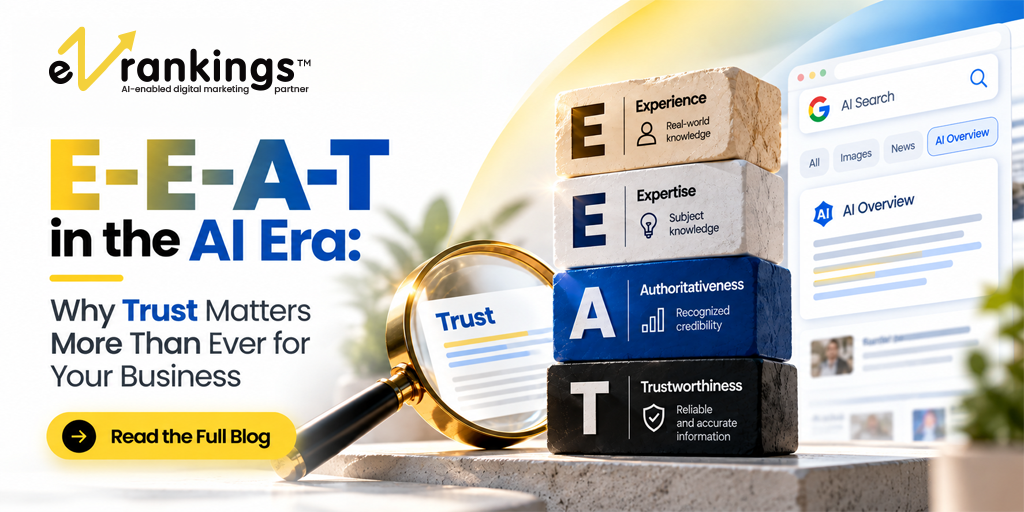
E-E-A-T stands for Experience, Expertise, Authoritativeness, and Trustworthiness. It is not a single score but a lens Google and, increasingly, AI systems use to judge whether your content deserves to be shown and believed.
Experience
This is the newest letter, and it asks a blunt question. Has the person creating this content actually done the thing? A review written by someone who used the product beats a summary assembled from other reviews, every time.
Expertise
Expertise is depth of knowledge in the subject. It shows in how precisely you explain hard ideas, how you handle edge cases, and whether a specialist would nod along or wince at what you wrote.
Authoritativeness
Authority is the reputation earned outside your own website. It is what others say about you, who links to you, and whether your brand is recognized as an entity in your field rather than an anonymous domain.
Trustworthiness (the most important “T”)
Trust is the letter everything else supports. Google has said plainly that it sits at the center. A page can be experienced, expert, and authoritative and still fail if users cannot trust its accuracy or intentions.
Why E-E-A-T Matters More Now Than Before
The shift is not subtle. The distance between publishing content and having it seen has grown, and trust is the filter in the middle.
AI Overviews and Chatbots Are Filtering Content Before Users See It
An AI answer is a gate. It reads dozens of sources, decides which few to trust, and shows the user a synthesized reply. If your content does not clear that trust bar, it is filtered out before a human ever gets the chance to click.
Flood of AI-Generated Content Has Made Trust Signals Scarce
The web is drowning in competent, generic, machine-written text. When everything reads fluently, fluency stops being a signal. Proof of real experience and verifiable authority become the scarce commodities that separate you from the noise.
Google and AI Systems Prioritize Verifiable Sources Over Generic Content
Systems now lean toward sources they can verify. A named author with credentials, original data, and consistent brand signals is easier to trust than a polished page with no fingerprints on it.
How AI Search Engines Evaluate Trust
Google AI Overviews, ChatGPT, Perplexity, Gemini & other LLMs do not think identically, but the trust signals they reward overlap more than teams assume. Strong E-E-A-T AI search performance comes from getting these fundamentals right.
-
Source Citation and Entity Recognition
These systems favor content they can attribute. Being a recognized entity, a brand with a consistent identity across the web, makes you easier to cite. If the machine cannot confidently identify who you are, it hesitates to name you. -
Author and Brand Reputation Signals
Reputation travels. Author expertise, brand mentions, and a coherent presence across platforms tell an AI system that quoting you is a safe bet. Fragmented or contradictory signals do the opposite. -
Content Originality vs AI-Generated Duplicate Content
Original thinking stands out because so little exists now. Content that only restates what ten other pages already said gives an AI system no reason to pick you over what you copied.
The Business Risk of Ignoring E-E-A-T
This is not a theoretical SEO debate. Weak trust signals carry real commercial costs.
-
Losing Visibility in AI Answers, Not Just Search Rankings
You can rank and still vanish. If an AI Overview answers the query using competitors as sources, your ranking exists but earns nothing. -
Erosion of Customer Trust in YMYL (Your Money, Your Life) Industries
In finance, health, and legal niches, trust is the product. Content that looks unverified or anonymous does more than underperform. It quietly warns visitors away when confidence matters most. -
Brand Being Misrepresented or Left Out of AI Summaries
When your signals are thin, AI systems fill the gap with whatever they can find, and sometimes get you wrong. Being misquoted or omitted from a summary shapes buyer perception before you enter the conversation.
How to Build Real “Experience” Signals
Experience cannot be faked convincingly, so build it in the open. Publish first-hand case studies with specifics, share original data you actually collected, and show proof of real product usage. Photos and video of genuine work and honest before-and-after results tell users and machines a human stood behind this page.
How to Build “Expertise” Signals
Attach real people to your content. Give authors detailed bios that state credentials and relevant experience, invite subject-matter contributors for technical pieces, and go deeper than the competing article dares to. Expertise shows in coverage that anticipates the follow-up question a novice would not think to ask.
How to Build “Authoritativeness” Signals
Authority is built off-site, over time. Earn links from credible, relevant publications, pursue digital PR that puts your experts in front of new audiences, and cultivate brand mentions even where no link follows. Industry recognition, awards, and citations by respected peers compound into a reputation that AI systems read as authority.
How to Build “Trustworthiness” Signals
Trust is built through consistency and transparency.
Want results like this for your business?
Talk to our SEO & AI visibility experts — no forms, no waiting.
Get a Free ProposalTransparent About Us and Author Pages
Make it effortless to learn who is behind the business. A real About page and named author profiles turn an anonymous domain into an accountable one.
Accurate, Fact-Checked, Regularly Updated Content
Wrong or outdated information erodes trust instantly. Fact-check claims, cite your reasoning, and revisit older content so it stays current rather than slowly rotting.
Secure, Well-Maintained Website (HTTPS, Privacy Policy, Contact Info)
The basics still matter. HTTPS, a clear privacy policy, and visible contact details signal a legitimate operation that stands behind its work.
20-Point E-E-A-T Audit Checklist for Your Website
Experience – You’ve actually done this
- Every key page names a real author (not “Admin” or “Team”) with a short bio
- Content includes original photos, screenshots, or examples from real work not stock images passed off as proof
- Case studies, before/after results, or client testimonials back up claims
- Product/service pages reflect first-hand use, not just spec-sheet copy
Expertise – You know the subject
- Author bios list relevant credentials, certifications, or years of experience
- Bios link to LinkedIn, professional profiles, or published work elsewhere
- Technical or YMYL topics (health, legal, finance) are written or reviewed by a qualified person, credited by name
- Content goes beyond surface-level summaries, depth and specifics, not recycled generic advice
Authoritativeness – Others recognize you
- About page is complete: company history, team, mission, credentials
- Site earns backlinks or mentions from respected, relevant industry sources
- Awards, certifications, media features, or partnerships are displayed where genuine
- Social profiles are active, linked, and consistent with the brand
Trustworthiness – You are safe and honest
- Site runs on HTTPS (padlock, no security warnings)
- Contact page has a real address, phone number, and email not just a form
- Privacy policy, terms of service, and (if relevant) refund/return policy are present and current
- Reviews are visible, verifiable, and linked to real platforms (Google, Trustpilot, etc.)
- No misleading headlines, clickbait, or claims the content doesn’t back up
Brand Perception in AI Search
- Search your brand name in Google, ChatGPT, and AI Overviews to see how you’re described
- Confirm business details (name, services, location) are consistent everywhere online inconsistent NAP data confuses AI systems
- Correct any inaccurate or outdated AI-generated descriptions by updating source pages (Wikipedia, Google Business Profile, press mentions) that AI tools likely pull from
Common E-E-A-T Mistakes Businesses Make in the AI Era
The pattern repeats across struggling sites. Teams over-rely on unedited AI-written content, publish thin generic pages that say nothing new, and ship articles with no author attribution at all. Many never include original data or real experience, leaving nothing a machine can verify. Each mistake strips away a trust signal, and together they make your brand invisible to the systems now deciding who gets quoted.
How E-E-A-T Connects to GEO and AEO
Generative Engine Optimization and Answer Engine Optimization are where trust and visibility now meet. GEO and AEO are about being chosen as a source inside AI-generated answers, and E-E-A-T is the qualifier that decides whether you make the cut. Strong E-E-A-T SEO foundations feed directly into GEO, because the same signals that earn a ranking now earn a citation. Optimizing for answer engines without trust is like buying a ticket to a race you are not allowed to enter.
FAQs
Is E-E-A-T a direct Google ranking factor?
Not directly. E-E-A-T is a framework Google’s raters and systems use to assess quality, and it shapes rankings through many connected signals.
Does AI-generated content hurt E-E-A-T?
It depends on how you use it. AI content that is unedited, generic, and unattributed damages trust. AI content refined by a real expert and grounded in genuine experience can support strong E-E-A-T SEO instead.
How can small businesses build E-E-A-T without a big team?
Start with what only you have. Real customer stories, first-hand experience, honest reviews, and a transparent About page cost little and build genuine trust faster than volume ever could.
How is E-E-A-T different in AI search vs traditional SEO?
In classic search, trust influenced where you ranked. In E-E-A-T AI search, trust decides whether you are cited at all, which raises the stakes from position to presence.
Conclusion
Trust has moved from a nice-to-have to the entry fee. As AI systems increasingly stand between your content and your audience, the brands that prove real experience, expertise, authority, and trustworthiness are the ones being seen, quoted, and chosen. Everyone else is publishing into a void they cannot measure. Building genuine E-E-A-T is slower than chasing quick wins, but it is the only strategy that compounds as E-E-A-T AI search keeps changing. If you want a clear-eyed audit of where your trust signals stand and a plan to strengthen them, the team at EZ Rankings is ready to help you earn your place in the answers that matter.

Mansi Rana
TEDx speaker and digital marketing expert with 22 years of experience driving business growth through innovation and strategy. Known for leadership rooted in both IQ and EQ, with a focus on ethical marketing and collaboration.
LinkedIn