Keyword research isn’t disappearing. It’s evolving. For decades, SEO started the same way every time; find keywords, check search volume, weigh the difficulty, and build content around them. That playbook built entire agencies and careers. But the ground has shifted. AI search now answers questions before a user ever clicks a link. Recent 2026 research shows that around 68% of Google searches now end without a single click. People still search constantly. They just don’t always land on your website.
Knowing what people type is no longer enough. You need to know why they search, where they search, and how AI platforms read those queries. That shift has a name, “Search Demand Research”. It picks up exactly where keyword research runs out of road, and it’s quickly becoming the smarter foundation for visibility.
The Evolution of Search
Search has never sat still, and neither has the way people use it. Each stage changed what a “search” even means.
- Traditional search: Users typed a few words into a box and scanned ten blue links.
- Mobile search: Searches got shorter and a lot more local. “Coffee near me” replaced typing out a whole question, and people expected an answer wherever they were standing.
- Voice search: Once people started talking to their phones, they stopped clipping their words. Full sentences and real questions became the norm.
- AI search: Instead of handing you a list of pages to sort through, engines just wrote the answer for you.
- Conversational search: Users now ask follow-ups, refine, and expect a dialogue, not a static results page.
The keyword stayed constant for a long time. Now the query itself is fluid, spoken, and often answered on the spot. Your strategy has to move with it, or it gets left behind.
What Is Traditional Keyword Research?
Traditional keyword research is the method most SEO teams have relied on for years. It centers on a handful of core metrics:
- Search volume: The number of people typing a term into Google each month.
- Keyword difficulty: This one tells you how tough the competition is. The higher it climbs, the harder it gets to break onto page one.
- CPC: What advertisers are willing to pay for a single click. It’s a handy clue about how much money sits behind a term.
- SERP analysis: Here you study the results page itself, whose ranking and what kind of content Google keeps rewarding.
- Keyword clustering: Grouping related terms into topics so you can plan whole pages instead of chasing one word at a time.
Why Traditional Keyword Research Is No Longer Enough
The problem isn’t that keywords stopped mattering. It’s that the results page changed underneath them.
- AI generates answers instead of links, so ranking first no longer guarantees a visit.
- Zero-click searches keep climbing as users get what they need on the page itself.
- AI Overviews summarize your content and cite it, often without sending any traffic.
- Conversational queries are longer and messier than any keyword tool can capture.
- Search now spreads across many platforms, not just Google.
- Behavior is intent-first. People want an answer, not a webpage.
Here’s a simple example. In Google, someone searches for “SEO Company.” In ChatGPT, that same person asks, “Which SEO agency is best for healthcare businesses?” Same underlying need, completely different query. A keyword tool sees the first one. It misses the second entirely.
What Is Search Demand Research?
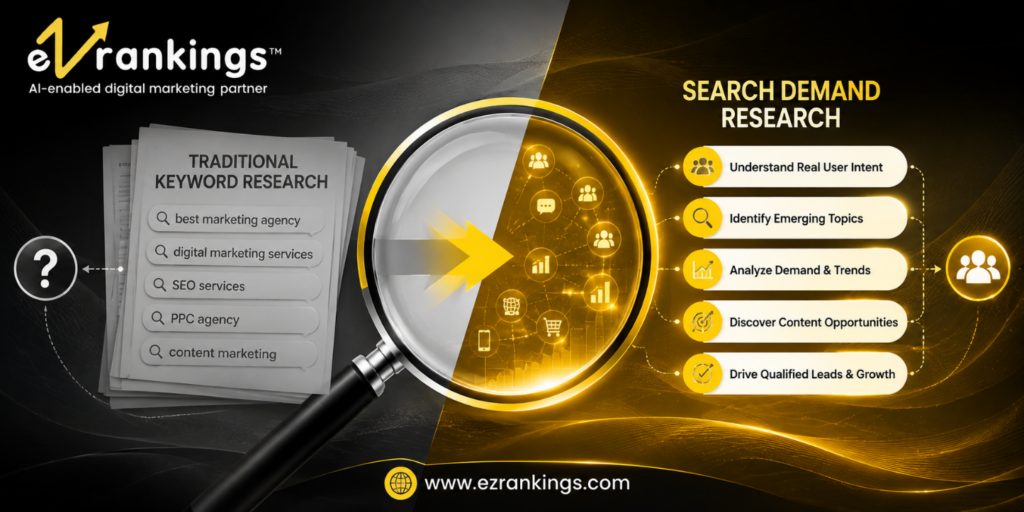
Search Demand Research is the practice of understanding the full demand behind a search, not just the words typed into a box. It maps five things:
- What users actually want
- Why they’re searching in the first place
- Where they search, across Google, AI tools, and communities
- How AI interprets and answers those searches
- Which content genuinely satisfies that demand
Instead of chasing keywords, you study the demand those keywords represent. Here’s the shift in plain terms:
| Traditional Keyword Research. | Search Demand Research |
|---|---|
| Keywords | Search demand |
| Search volume | User intent |
| Keyword difficulty | Search surface |
| SERP analysis | AI ecosystem |
| Rankings | Visibility everywhere |
One approach optimizes for a position on one page. The other optimizes for presence across every place your audience looks.
The Four Pillars of Search Demand Research
Intent Mapping
Intent mapping sorts searches by where the person sits in their decision. Not every query deserves the same response.
- Problem aware: They feel pain but don’t know the fix yet. “Why is my website traffic dropping?”
- Solution aware: They know the category of answer. “What is technical SEO?”
- Comparison: They’re weighing options. “Ahrefs vs Semrush.”
- Transactional: They’re ready to act. “Hire an SEO agency.”
When you map intent, you stop writing generic pages and start answering the real question behind each search. That’s also what AI engines reward, because they’re built to match answers to intent, not just words on a page.
Entity Mapping
Entities are the people, brands, products, and topics that search engines and AI models recognize as real, connected things. Modern search doesn’t only read keywords. It understands relationships. Entity mapping means defining how your world connects:
- Brand: Your name, and the way people describe you when they talk about it.
- Founder: The people behind the business.
- Competitors: Whoever you get stacked up against.
- Category and places: What you actually do, plus the locations where you do it.
AI models pull from this web of associations when they decide who to mention. If your brand isn’t clearly connected to your category, you simply won’t show up in AI answers. Entities are how machines know you exist.
Surface Mapping
Search no longer happens in one place. Surface mapping identifies every platform where your audience looks for answers, so you know exactly where to show up:
- Google and AI Overviews
- ChatGPT, Gemini, and Perplexity
- Reddit and community threads
- YouTube
Each surface plays by its own rules. What ranks well on Google may never surface in Perplexity, and a thread that dominates Reddit might be invisible on other platform. Mapping these surfaces tells you where demand actually lives, so you can create content for the places that matter most instead of guessing and hoping.
Demand Mapping
Demand mapping is where Search Demand Research breaks hardest from the old model. Demand is not just monthly search volume. Volume only counts what’s already popular and already tracked. Real demand is wider:
- Emerging topics your keyword tools haven’t even registered yet
- The actual prompts people type into chat tools like ChatGPT
- Community threads, where fresh questions tend to pop up first
- Seasonal interest that climbs and drops throughout the year
- Business demand that follows buying cycles and budget calendars
Reading demand this widely means you spot interest while it’s still forming, well before it turns into a keyword everyone’s already scrapping over. That head start is the whole point. You get to move first while your competitors are still waiting for the data to catch up.
The Search Demand Research Process
Search Demand Research works best as a repeatable system. You’re not hunting for one clever keyword. You’re building a picture of demand and then meeting it everywhere it lives. Here’s how the process runs, step by step. It’s important to understand each step in detail to ensure you optimize your website’s performance accordingly. Right from discovery search demand to measuring visibility, we will explore each step.
Step 1: Discover Search Demand
Start by finding what people actually want, not just what they type. Look beyond your keyword tool. Read the questions people ask in Google’s related searches, in AI chat tools, on Reddit, and in your own customer emails and support tickets. Note the exact language they use. Spot the questions that keep repeating. At this stage you’re gathering raw demand signals from as many places as possible. The goal is range, not precision. You want to see the full shape of what your audience is trying to solve, including the messy, spoken, half-formed questions that keyword databases never record.
Step 2: Map User Intent
Once you have demand, sort it by intent. Group every question by where the searcher stands. Are they just noticing a problem, comparing solutions, or ready to buy? A single topic usually holds all three. Take “email marketing.” One person wants to know what it is. Another wants the best tool. A third is ready to hire someone. Same topic, three different needs. Mapping intent tells you what kind of content each query deserves, so you never answer a beginner’s question with a sales page or hit a ready buyer with a basic definition.
Step 3: Identify Entities
Next, define the entities tied to your topic and your brand. List the people, products, competitors, and categories AI models should associate with you. Then check whether those connections actually exist online. Does your brand get mentioned alongside your category? Is your founder linked to your area of expertise? Are you cited in the same conversations as your competitors? Where the links are weak, you have work to do. Strengthening these associations, through content, mentions, and consistent descriptions, is how you teach AI systems who you are and when to bring you up.
Want results like this for your business?
Talk to our SEO & AI visibility experts — no forms, no waiting.
Get a Free ProposalStep 4: Analyze Search Surfaces
Next, figure out where your demand is actually getting answered right now. Take your key questions and run them through Google, ChatGPT, Gemini, and Perplexity to see who keeps showing up, then do the same across Reddit threads and YouTube. Every surface tells you something a little different. Google might reward long, thorough guides while Perplexity leans on quick, factual pages, and you may find competitors owning the conversation on Reddit while completely ignoring YouTube. What you’re really hunting for are the gaps, those spots where people clearly want answers but nobody good has stepped up yet.
Step 5: Prioritize Opportunities
You simply can’t chase all of it at once. Once you’ve mapped demand, intent, entities, and surfaces, put each opportunity side by side and weigh the effort against what you’d get back. A few topics will jump out with strong demand and barely any competition. Start there. Others sit close to a purchase decision, so they’re worth the effort even when the volume looks small. Factor in where you can realistically win. A gap on Perplexity you can fill this week beats a Google keyword that takes a year to rank. Prioritizing keeps you focused on work that moves visibility and revenue, not just work that fills a content calendar.
Step 6: Create Content
Now you build, guided by everything you’ve learned. Each piece answers a real question, matches a specific intent, reinforces your entities, and fits the surface it’s meant for. A comparison page reads differently than a beginner guide. Content aimed at AI citation stays clear, factual, and cleanly structured so models can quote it without stumbling. You’re not writing to stuff keywords. You’re writing to satisfy demand that both people and AI engines treat your page as the best answer available. That’s what earns visibility now, on Google and everywhere else.
Step 7: Measure Visibility
Finally, track results, but measure more than rankings. Rankings tell a shrinking part of the story. Watch whether AI tools mention or cite your brand. Check if you appear inside AI Overviews. Monitor traffic, but also monitor presence, the moments your brand shows up in an answer even without a click. Note which surfaces send real visitors and which build awareness. This wider view shows whether your demand research is working. When your brand starts appearing across platforms and inside AI answers, you know you’re capturing demand, not just chasing keywords.
Traditional Keyword Research vs Search Demand Research
The difference is easiest to see side by side. Same goal of visibility, two very different roads to reach it.
| Parameter | Traditional Keyword Research. | Search Demand Research |
| Research goal | Rank for keywords | Capture demand everywhere |
| Metrics | Volume, difficulty, CPC | Intent, entities, demand signals |
| Search behavior | Typed, predictable queries | Conversational, cross-platform |
| AI compatibility | Limited | Built for AI search |
| Content planning | Keyword-led | Intent and demand-led |
| Intent | Often assumed | Explicitly mapped |
| Platforms | Mostly Google | Google, AI tools, communities |
| Visibility | Page rankings | Presence across surfaces |
| Success metrics | Rankings and clicks | Citations, mentions, visibility |
Keyword research optimizes for one page in one place. Search Demand Research optimizes for every place a decision gets made.
How to Incorporate Search Demand Research into Your SEO Strategy
You don’t have to tear down your current process. You upgrade it. Where your workflow used to start with keyword research, it now starts with something broader. Instead of opening a keyword tool first, begin with search demand analysis. Then layer in the rest:
- Intent mapping to sort demand by what people actually need
- Prompt research to see how people ask AI tools, not just Google
- Entity mapping to strengthen how AI connects you to your category
- Surface analysis to find where your audience really searches
- Content journey mapping to guide people from first question to final decision
- AI visibility tracking to measure presence across platforms, not just rank
Keywords still have a place. They become one input among several, not the starting line. The teams winning right now treat keywords as a clue to demand, then build around the demand itself.
The Future of Search Demand Research
This is still early. The direction, though, is already clear, and it points away from the ten blue links for good.
- AI agents will search, compare, and even buy on a user’s behalf, so your brand has to be readable by machines, not just people.
- Personalized search will tailor results to each user’s history and context.
- Multimodal search will blend text, voice, and images into a single query.
- Conversational commerce will let people research and purchase inside a chat window.
- Predictive search will surface answers before users finish asking.
In every one of these shifts, the winners won’t be whoever ranks for a keyword. They’ll be whoever understands demand deeply enough to show up at the exact moment it appears. Search Demand Research is how you prepare for that now, instead of scrambling later.
Conclusion
Keyword research had a good, long run. It gave SEO a clear starting point and a shared language for years. But the search world it was built for is fading. AI now answers questions directly, users move fluidly across platforms, and a top ranking no longer guarantees a single visitor. The old map still shows some roads. It just doesn’t show the whole territory anymore.
Search Demand Research widens the view. Instead of asking only “what keywords should we target,” it asks better questions. What do people actually want? Why are they searching? Where do they look? How does AI read and answer them? Which content truly satisfies that need? Answer those, and you stop optimizing for one results page and start showing up everywhere your audience makes decisions.
The businesses that thrive from here will be the ones who understand intent, entities, search surfaces, and real demand, then build content around all four. Keywords become a clue, not the whole strategy.
At EZ Rankings – Best performance marketing agency in India, this is exactly where we help brands move. Our team builds Search Demand Research into SEO and AI visibility strategies that get you found on Google, inside AI Overviews, and across the tools your customers now trust. If you’re ready to stop chasing rankings and start capturing demand, let’s talk about what that looks like for your business.
Frequently Asked Questions
How is Search Demand Research different from keyword research?
Keyword research focuses on individual terms, how often they get searched, and how tough they’ll be to rank for. The whole thing rests on a tidy assumption; someone types a keyword, scans a list of links, and clicks one of them. Search Demand Research pulls the camera back. It looks at everything driving that search, what the person actually wants, why they’re asking in the first place, where they go looking, and how AI decides to answer them. Keywords still matter here, but they’re just one clue among several rather than the entire story.
What is Intent Mapping?
Intent mapping is the practice of sorting searches by what the person actually wants to accomplish. Two people can search for similar words for very different reasons. One is just noticing a problem. Another is comparing solutions. A third is ready to buy. Intent mapping groups queries into stages, usually problem aware, solution aware, comparison, and transactional. This tells you what kind of content each search deserves. It stops you from answering a beginner’s question with a sales pitch, and it matches how AI engines work, since they’re designed to serve answers based on intent, not just matching words.
What is Entity Mapping?
Entity mapping defines the people, brands, products, competitors, and topics that search engines and AI models associate with you. Modern search understands relationships, not just keywords. It knows a brand connects to a founder, a category, and a set of competitors. Entity mapping makes those connections clear and consistent across the web. This matters because AI models decide who to mention based on these associations. If your brand isn’t strongly linked to your category, AI tools won’t bring you up in their answers.
What is Search Surface Analysis?
Search surface analysis is the process of identifying every platform where your audience searches, then studying how each one answers their questions. Search no longer lives only on Google. People ask ChatGPT, Gemini, and Perplexity, browse Reddit threads, and watch YouTube. Each surface behaves differently and rewards different content. Surface analysis means running your key questions through these platforms to see who shows up and why. It reveals gaps where demand exists but strong answers don’t.
How do AI search engines understand user intent?
AI search engines pick up on far more than the keywords themselves. They look at how a query is phrased, the context around it, and the way the words relate to one another, all to work out what the person is really getting at. A question like “best CRM for a small law firm” tells the model the user, the need, and the constraint all at once. AI systems draw on entities, past patterns, and huge amounts of training data to match that intent to the most useful answer.
What tools help with Search Demand Research?
Search Demand Research uses a mix of familiar and newer tools. Traditional keyword platforms still help you gather baseline demand and volume. From there, you go straight to the AI tools themselves, running your queries through ChatGPT, Gemini, and Perplexity to watch how each one answers and, just as importantly, which sources it decides to cite. Community platforms like Reddit and question sites reveal real, unfiltered demand. Your own analytics, customer emails, and support tickets are goldmines for intent. No single tool does everything yet.
How does Search Demand Research improve SEO?
Search Demand Research strengthens your SEO by rooting it in real demand rather than guesswork. Get the intent right and your content answers the exact question sitting behind a search, which keeps people reading and quietly tells search engines your page is worth trusting. Map your entities well, and AI systems start recognizing your brand and pulling it into their answers. Study the surfaces, and you turn up wherever your audience is actually searching, not just on Google.
Can Search Demand Research improve AI visibility?
Yes, and that’s one of its biggest strengths. AI tools like ChatGPT, Gemini, and Perplexity decide what to mention based on intent, entities, and how clearly content answers a question. Search Demand Research targets all three directly. By mapping intent, you create content that matches how people ask AI tools. By strengthening entities, you help models connect your brand to your category. By writing clear, factual, well-structured pages, you make your content easy to quote.
How often should businesses update their Search Demand Research?
Search Demand Research isn’t something you do once and file away. Demand keeps shifting, new topics pop up, AI platforms change how they work, and buying habits swing with the seasons. A rhythm that works well for most teams is a quick check every month and a deeper refresh once a quarter. Keep an eye out for fresh questions in your space, shifts in how AI tools answer the queries you care about, and new gaps opening up on different surfaces. If you’re in a fast-moving industry, you’ll probably want to look more often than that.

Mansi Rana
TEDx speaker and digital marketing expert with 22 years of experience driving business growth through innovation and strategy. Known for leadership rooted in both IQ and EQ, with a focus on ethical marketing and collaboration.
LinkedIn