Where to Spend Your Marketing Budget in 2027: SEO, Paid Ads or AI Search?
In 2027, most businesses should stop asking which single channel to fund. Paid ads buy the demand you need this quarter. SEO builds owned visibility that lowers acquisition cost over time. AI search optimization decides whether your brand is named when a buyer asks ChatGPT, Gemini or Google’s AI Overviews for a recommendation. As a starting point, a new brand might put about 55% into paid ads, 30% into SEO and 15% into AI search, while an established brand moves closer to 30%, 35% and 35%. The right split depends on your growth stage, sales cycle and how much authority your brand already has.
Here is how we think about it at EZ Rankings, after 16+ years of running search and performance programmes across 28+ countries.
What Changed in 2026?
Three shifts happened at once, and together they broke the old budgeting logic.
Organic clicks got scarcer. Ahrefs re-ran its study of 300,000 keywords and found that when an AI Overview appears, the top-ranking page now gets about 58% fewer clicks, up from a 34.5% drop in its April 2025 study. SparkToro’s analysis of US Google searches from January to April 2026 found roughly two-thirds ended without a click to any website. Ranking first no longer guarantees traffic, which is why we now optimize for search engines and AI answers together through hybrid engine optimization.
Paid clicks got pricier. WordStream and LocaliQ’s 2026 Google Ads benchmarks put the average cost per click at $5.42, up from $4.66 in 2024. When organic clicks shrink, more advertisers compete for the paid ones, and auction prices follow.
A new front door opened. ChatGPT reached around 900 million weekly users by early 2026, and OpenAI’s CEO said India alone had crossed 100 million weekly users. Adobe reported that AI-referred visits to US retail sites grew 393% year over year in Q1 2026 and converted 42% better than other traffic.
The cheapest click (organic) is shrinking, the click you can buy (paid) costs more, and more research now happens inside AI answers you cannot bid on.
SEO vs Paid Ads vs AI Search: How They Compare
Each channel buys something different. This is the quickest way to see where your money goes:
| Factor | Paid ads (Rent) | SEO (Own) | AI search (Be Named) |
|---|---|---|---|
| What you pay for | Clicks and impressions | Content, technical work and links | Authority, mentions and answer-ready content |
| Speed to first results | Days | 3–6 months | 3–6 months for first citations |
| What happens when you stop | Traffic stops immediately | Visibility fades slowly | Mentions persist while your authority holds |
| Cost trend | Rising (higher CPCs) | Falls per lead over time | Mostly upfront effort, then upkeep |
| Best for | Launches, new markets, pipeline this quarter | Long-term, lower-cost leads | Being recommended when buyers ask AI tools |
| Main KPI | Cost per qualified lead | Organic leads and revenue | AI share of voice and branded search |
Should You Still Invest in SEO in 2027?
Yes, but for a different reason than before.
SEO is now the raw material AI systems draw from. When Google, ChatGPT or Perplexity assemble an answer, they lean on pages that are crawlable, clearly structured, factually specific and trusted. A weak site is invisible to both the search engine and the answer engine.
Seer Interactive’s 2026 data shows why. On searches with an AI Overview, pages cited inside the overview earned roughly twice the click-through rate of pages that were not cited. So the job of SEO has moved from “rank the page” to “be the source the answer is built from.”
What we would protect in a 2027 SEO budget:
- Technical health:fast, crawlable pages with clean schema markup.
- Bottom-funnel pages:service, pricing-logic, comparison and location pages, where buyers still click.
- Original information:first-party data, expert commentary and specifics no competitor can copy.
If you want these covered as a fixed monthly plan, our monthly SEO packages are built around exactly these three priorities.
What we would cut: high-volume informational blog posts written only to chase keywords, unless they carry original data or expert insight. Generic informational queries are exactly the ones AI Overviews now answer on the results page.
Is Paid Advertising Still Worth It?
Paid search remains the only channel that delivers predictable volume on demand. If you are launching, entering a new market or need a pipeline this quarter, nothing replaces it.
To see what rising CPCs mean in practice: at the 2026 average of $5.42 a click and a 5% conversion rate, each lead costs about $108. Cut wasted clicks by a fifth and the same budget delivers a fifth more leads. That’s where most of the gains in PPC management services come from in 2027: fewer wasted clicks, not bigger budgets.
Rising CPCs punish waste faster than ever. In 2027, paid budgets earn their keep through tight targeting on high-intent terms, landing pages built to convert, and honest attribution that separates new demand from customers who would have found you anyway.
There is also a useful overlap: Seer found brands cited in an AI Overview earned higher paid click-through rates on the same queries. Organic authority makes paid spend work harder, so the two budgets are no longer separate decisions.
What Exactly Is “AI Search” Spent On?
There is no ad auction to buy into here. AI search visibility, often called GEO (generative engine optimization) or AEO (answer engine optimization), is earned. In practice the budget goes into:
- Answer-ready content:pages that state a clear answer in the first two sentences, then support it with evidence.
- Entity clarity:consistent business information, structured data and author credentials, so AI systems understand who you are and what you are expert in. We explain these trust signals in our guide to E-E-A-T in the AI era.
- Third-party mentions:digital PR, expert quotes, reviews and listings on sites AI models already trust. AI answers rarely cite only your own website.
- Measurement:tracking how often your brand appears in AI answers for your core buying questions, not just rankings.
A word of caution: AI referral traffic is still small. Ahrefs estimated that AI chatbots sent well under 1% of total web traffic in early 2026, and one ecommerce study found non-branded organic search still delivered about 70 times more sessions than ChatGPT. AI visibility is a fast-growing influence channel, not yet a volume channel. Fund it as a strategic bet, not a replacement for search.
What This Looks Like in Practice
A UK-based online Indian grocery store ranked in Google’s top 5 for searches like “basmati rice online” and “phool makhana online”, but AI answers for the same searches cited other stores. We kept its paid and SEO budgets steady and added focused AI search work: clearer answers on category and product pages, better page structure and stronger trust signals. Within 45 days, it was cited in Google AI Overviews and ChatGPT answers for those searches.
How Much Should You Spend on Marketing Overall?
Before splitting the budget, set the total. Gartner’s CMO Spend Survey found that marketing budgets averaged 7.7% of company revenue in 2025. Fast-growing and venture-backed companies often spend well above that, while established businesses with strong referral pipelines can spend less.
A practical rule: work back from your target. If you need 40 new customers a month and your best channel delivers them at ₹7,500 each, your working budget for that channel is ₹3,00,000 a month. Then split the total using the framework below.
How Should You Split Your 2027 Marketing Budget?
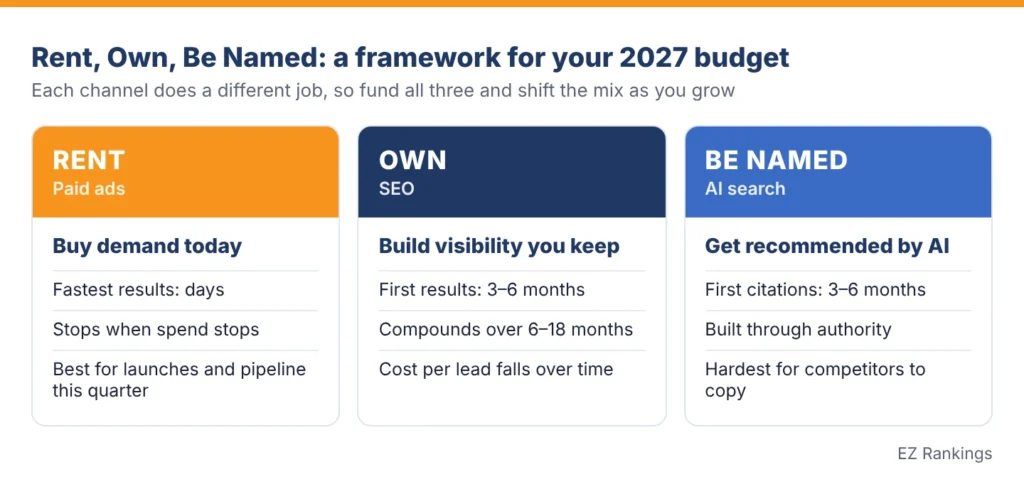
We use a simple framework with clients we call Rent, Own, Be Named:
- Rent(paid ads): demand you buy today. Stops the moment you stop paying.
- Own(SEO): visibility you build once and keep. Compounds over 6 to 18 months.
- Be Named(AI search): the brand an AI recommends when a buyer asks. Built through authority, slowest to earn, hardest for competitors to copy.
Starting allocations we would test, before adjusting to your data:
Want results like this for your business?
Talk to our SEO & AI visibility experts — no forms, no waiting.
Get a Free Proposal| Business stage | Rent (Paid) | Own (SEO) | Be Named (AI search) |
|---|---|---|---|
| New brand or new market | 55% | 30% | 15% |
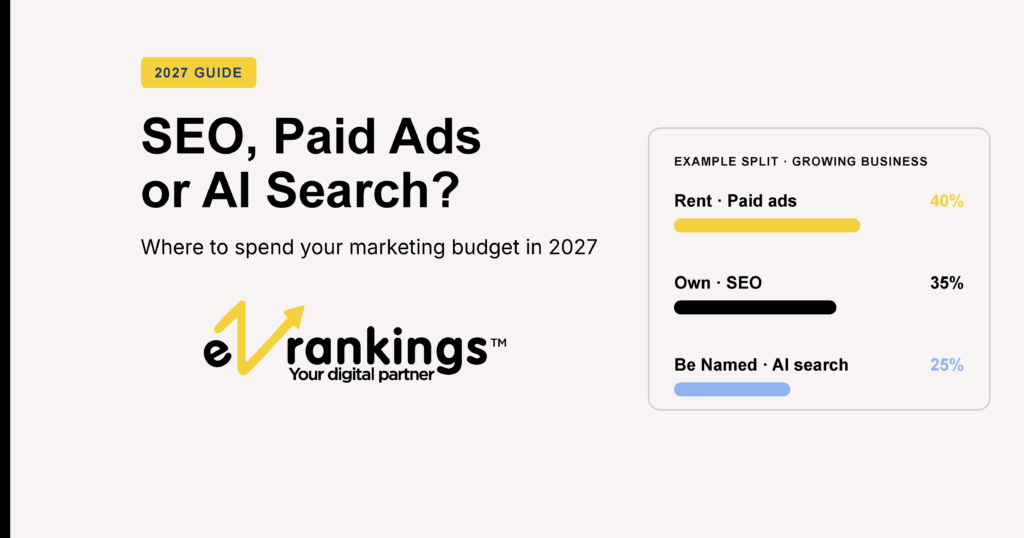
| Growing, lead-driven business | 40% | 35% | 25% |
| Established brand with strong authority | 30% | 35% | 35% |
These are starting points, not rules. A B2B firm with a long sales cycle should lean further into Own and Be Named; a D2C brand mid-launch may need Rent to carry the quarter. Review the split every 90 days against cost per qualified lead.
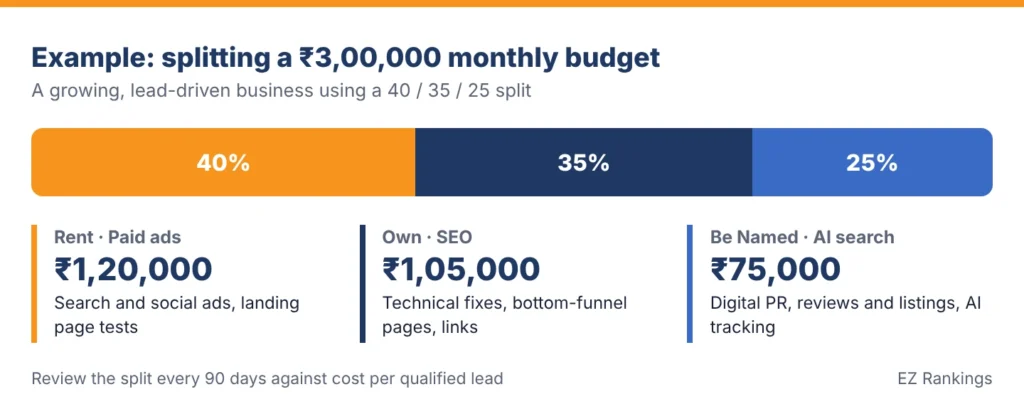
Example: Splitting a ₹3,00,000 Monthly Budget
A growing, lead-driven business using the 40 / 35 / 25 split from the table:
| Bucket | Share | Monthly amount | What it typically funds |
|---|---|---|---|
| Rent (paid ads) | 40% | ₹1,20,000 | Search and social ads on high-intent terms, plus landing page testing |
| Own (SEO) | 35% | ₹1,05,000 | Technical fixes, 3–4 bottom-funnel pages a month, link building |
| Be Named (AI search) | 25% | ₹75,000 | Digital PR and expert quotes, review and listing work, AI visibility tracking |
| Total | 100% | ₹3,00,000 |
Revisit the split after 90 days. If paid ads deliver leads below your target cost, shift more there for the next quarter; if organic leads start to grow, move budget toward SEO and AI search.
How the Split Changes by Business Type
Use the growth-stage table as your base, then adjust for how your customers buy:
| Business type | Lean toward | Why | Where we’d start |
|---|---|---|---|
| B2B with long sales cycles | Own + Be Named | Buyers research for weeks and ask AI tools for shortlists | 30% paid · 40% SEO · 30% AI search |
| Ecommerce and D2C | Rent during launches, then Own | Shopping ads drive sales now; product and category SEO lowers cost later | 45% paid · 35% SEO · 20% AI search |
| Local services (clinics, salons, contractors) | Own (local SEO) | Google Business Profile and map results drive calls | 35% paid · 45% SEO · 20% AI search |
For ecommerce brands, our ecommerce digital marketing agency team builds this mix around your catalogue. For clinics and service-area businesses, local SEO services usually deliver the fastest organic return.
How Long Each Channel Takes to Pay Off
| Channel | First results | Meaningful return | What to expect |
|---|---|---|---|
| Paid ads | Days | 1–3 months (once optimized) | Fast but stops when spend stops |
| SEO | 3–6 months | 6–18 months | Compounds; cost per lead falls over time |
| AI search | 3–6 months (first citations) | 6–12 months | Depends on authority beyond your own site |
How to Measure Whether Your 2027 Marketing Budget Is Working
Traffic is now a misleading scorecard, since AI answers influence buyers who never click. Track these instead:
- Cost per qualified lead and cost per acquisition, by channel
- Branded search volume over time (a good proxy for AI-driven awareness)
- How often your brand is cited in AI answers for your top 20 buying questions
- Conversion rate of AI-referred visitors, tagged separately in your analytics
How to Rebalance Your Budget Every 90 Days
- Pull cost per qualified lead for each channel for the last 90 days.
- Check branded search volume and AI answer mentions against the previous quarter.
- Move 10–15% of budget toward the channel with the lowest cost per qualified lead, unless it’s AI search or SEO in its first six months, which need time to build.
- Write down why you moved it, so the next review can check whether the change worked.
For the full list of metrics and how to calculate them, see our KPI playbook for SEO and AI search.
The Bottom Line for 2027
The winners next year will make each channel strengthen the others: paid ads to capture demand now, SEO to own the pages buyers and AI systems rely on, and authority-building so your name is in the answer when a customer asks an AI who to trust.
Start with a simple test. Ask ChatGPT, Gemini and Google the five questions your best customers ask before buying. If your brand does not appear, that gap is where your 2027 budget conversation should begin. EZ Rankings offers a free website and AI visibility analysis that maps exactly this, across search, paid and AI platforms.
Frequently Asked Questions
Is SEO dead because of AI Overviews?
No. AI Overviews reduce clicks on informational queries, but they draw their answers from well-optimized pages. SEO now determines whether you are the source of the answer.
Can I pay to appear in ChatGPT or AI Overviews?
Ad formats inside AI answers are still emerging. Organic AI visibility is earned through content quality, structured data and third-party authority.
How long does AI search optimization take to show results?
Expect three to six months for measurable citation gains, longer in competitive categories, since it depends on building authority beyond your own website.
What percentage of my budget should go to SEO vs paid ads?
It depends on your stage. New brands often start with about 55% paid and 30% SEO, because they need leads before organic visibility builds. Established brands usually shift to about 30% paid and 35% SEO, with the rest in AI search. Review the split every 90 days against cost per qualified lead.
Is SEO or paid ads better for a small business?
Most small businesses need both. Paid ads bring leads quickly while SEO builds a cheaper, lasting source of customers. If budget is very tight, local businesses usually get the best long-term return from local SEO and Google Business Profile, with a small paid budget for their most valuable services.
What is GEO, and do I need a separate budget for it?
GEO (generative engine optimization) is the work of getting your brand mentioned and cited in AI answers from tools like ChatGPT, Gemini and Google AI Overviews. It overlaps with SEO, but needs its own line in the budget because much of the work, such as digital PR and third-party mentions, happens off your website.
How long does SEO take to pay off compared with paid ads?
Paid ads can bring leads within days. SEO usually shows first results in three to six months and builds meaningful returns over six to eighteen months, but its cost per lead keeps falling while paid costs keep rising.
How much should a small business in India spend on digital marketing?
Start from your sales target rather than a fixed number: work out how many customers you need each month and what you can afford to pay for each one. Many small businesses begin with a fixed monthly plan such as bundled digital marketing packages, then add budget to whichever channel delivers the lowest cost per lead.

Mansi Rana
TEDx speaker and digital marketing expert with 22 years of experience driving business growth through innovation and strategy. Known for leadership rooted in both IQ and EQ, with a focus on ethical marketing and collaboration.
LinkedIn