
Here is a question worth sitting with – when was the last time you searched for a product on Google rather than going straight to Amazon or Flipkart? For most buyers, that shift happened years ago. Marketplaces have become the default starting point for product discovery, and brands that have not caught up to that reality are losing sales they do not even know about.
Marketplace Optimization, or MPO, is how you fix that. It is the process of improving your product listings so they rank higher within marketplace search results, earn more clicks, and convert more of those clicks into actual purchases. It covers everything from how your title is written to which images you use, how you price against competitors, and how well your reviews hold up.
What is Marketplace Optimization (MPO)?
Marketplace Optimization (MPO) is the ongoing work of making your product listings perform better within a specific marketplace’s search and ranking system. That includes your product title, description, images, pricing, reviews, backend keywords, and fulfilment performance. Each of these elements influences how the marketplace algorithm ranks your product and whether a buyer chooses yours over a competitor’s.
The core idea behind MPO is discoverability. Buyers on Amazon or Walmart search for products the same way they search on Google, except the algorithm deciding what to show them is completely different. It does not care about your domain authority or how many backlinks your website has. It cares about whether your listing is relevant, whether buyers click on it, and whether they buy after clicking.
Why Marketplace Optimization Matters for Ecommerce Brands
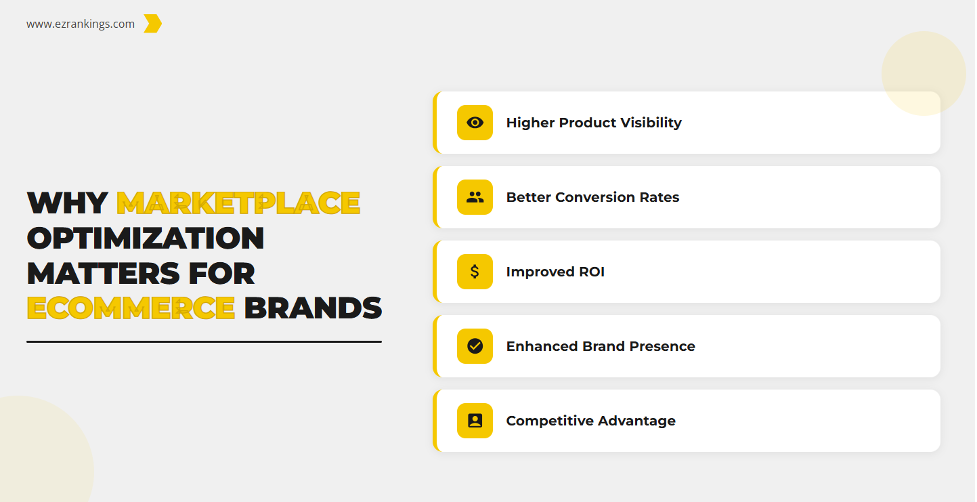
Higher Product Visibility
Buyers on marketplaces hardly go beyond the first page of results. If your product is not there, it is effectively invisible. Marketplace Optimization (MPO) improves your position in those results by aligning your listing with what the platform’s algorithm values most. That means more impressions, more clicks, and more opportunities to convert buyers who are already actively looking for what you sell. Unlike traffic from a broad Google search, marketplace impressions come from people already in purchasing mode.
Better Conversion Rates
There is a gap between getting clicks and making sales, and a well-optimized listing usually fills that gap. When a buyer lands on your listing and finds a vague title, blurry images, and a description that reads like a spec sheet, they leave. When they land on a listing that answers their questions clearly, shows the product from every angle, and explains why it is the right choice for them, they buy. MPO closes that gap by making every element of your listing work harder.
Improved ROI
Organic ranking improvement through MPO means you need to spend less on paid ads to maintain visibility. That directly improves your return on every dollar invested in your marketplace presence. It also reduces the downstream costs of poor listing quality, including high return rates from buyers who got the wrong impression of the product, and low repeat purchase rates from buyers who felt misled.
Enhanced Brand Presence
When a brand approaches its listings with seriousness, buyers notice. When the content is written well and the images are consistent and clean, it will communicate professionalism that can’t be conveyed using a generic listing. This is especially crucial with a category that is highly competitive and has several sellers who are selling products that look very similar. The brand that looks after themselves is memorable and so is the review rate, repeat sales, and word of mouth.
Competitive Advantage
The majority of sellers on any given marketplace are not doing thorough MPO. They list their products, run a few ads, and monitor sales without ever addressing the underlying quality of the listing itself. This is good news for brands willing to do the work. Proper keyword research, tested titles, high-quality images, and regular listing audits let you outrank competitors with comparable or even better products.
Marketplace Optimization (MPO) Strategies That Improve Visibility, Sales and ROI
Marketplace Keyword Research
Keyword research for marketplaces is not the same as keyword research for Google. The frame shifts from what people search to what people search when they are ready to buy. These buyer-intent keywords are the ones that matter most, because the buyers using them are not browsing. They are deciding. Tools built specifically for marketplace research, including Helium 10, Jungle Scout, DataHawk, and SellerApp, help you identify these terms along with their search volume within the marketplace itself.
Product Title Optimization
Your product title is the first thing both the algorithm and the buyer see. It has to do two jobs at once, and they are not always in perfect harmony. The algorithm wants keyword relevance. The buyer wants to understand what the product is in a single glance. A title that serves one at the expense of the other will underperform.
The structure that tends to work best starts with the brand name, then the product type, then the key features that matter most to a buyer, such as size, colour, material, or compatibility.
Product Description Optimization
Most product descriptions fail because they describe the product rather than selling it. Features tell you what something is. Benefits tell you what it does for you. The difference in conversion rate between these two approaches is significant. A jacket with a waterproof rating is a feature. A jacket that keeps you dry during an unexpected downpour on your morning commute is a benefit. One of those makes a buyer feel something. The other does not.
Product Image Optimization
Feature images highlight important details. Lifestyle shots place the product in a real life context and let the buyer imagine themselves using the product. For those who prefer to scan over reading, infographics are used to layer relevant information directly onto the image. Reduces returns of a size guide image. The 60 degree shot creates dimension and depth which photographers on flat shots lack. Take at least 2000 pixels on the longest side to allow for zoom operations, many customers use this feature prior to purchase.
Backend Search Term Optimization
Most major marketplaces include a backend keyword field in the listing setup, a space where you can add search terms that the algorithm indexes but buyers never see. This is not optional. It is one of the most direct ways to signal relevance to the algorithm for searches that did not fit naturally into your visible listing.
Use this space for alternate keywords, synonyms, regional variations, and related terms. If you sell sunglasses, your backend terms might include shades, eyewear, sunnies, and commonly misspelled variations.
Product Reviews and Ratings Optimization
Reviews affect rankings more directly on marketplaces than most sellers expect. On platforms like Amazon, review volume and average rating score are treated as first-class ranking signals. A product with 400 strong reviews will consistently outperform a comparable product with 30, even when the second product has a better listing in every other respect.
Building reviews takes time and care. A strong post-purchase experience, good packaging, and thoughtful follow-up communication all contribute to genuine feedback over time.
Pricing and Competitive Analysis
Dynamic pricing tools let you adjust in response to competitor movements, demand shifts, and seasonal changes rather than setting a price once and hoping it holds. On Amazon, Buy Box eligibility is largely determined by price, fulfilment method, and seller performance metrics.
Winning it consistently requires staying competitive on all three. Strategic discounts through coupons and limited-time promotions can accelerate sales velocity, which feeds positively back into organic ranking. The goal is to stay competitive on price while your listing quality justifies a margin that makes the business sustainable.
Inventory and Fulfilment Optimization
Stock-outs are one of the more damaging things that can happen to a marketplace ranking. When you go out of stock, most algorithms treat it as a reliability problem and drop your position. Recovering that ranking after you restock can take weeks of strong sales performance.
The Fulfilment method also plays a role in ranking on most platforms. Amazon FBA and Walmart Fulfilment Services both carry ranking benefits because fast, reliable delivery improves the buyer experience the platform is trying to deliver. Third-party logistics providers can achieve comparable results if they consistently hit the delivery standards the marketplace expects.
Marketplace SEO vs Traditional SEO
Want results like this for your business?
Talk to our SEO & AI visibility experts — no forms, no waiting.
Get a Free Proposal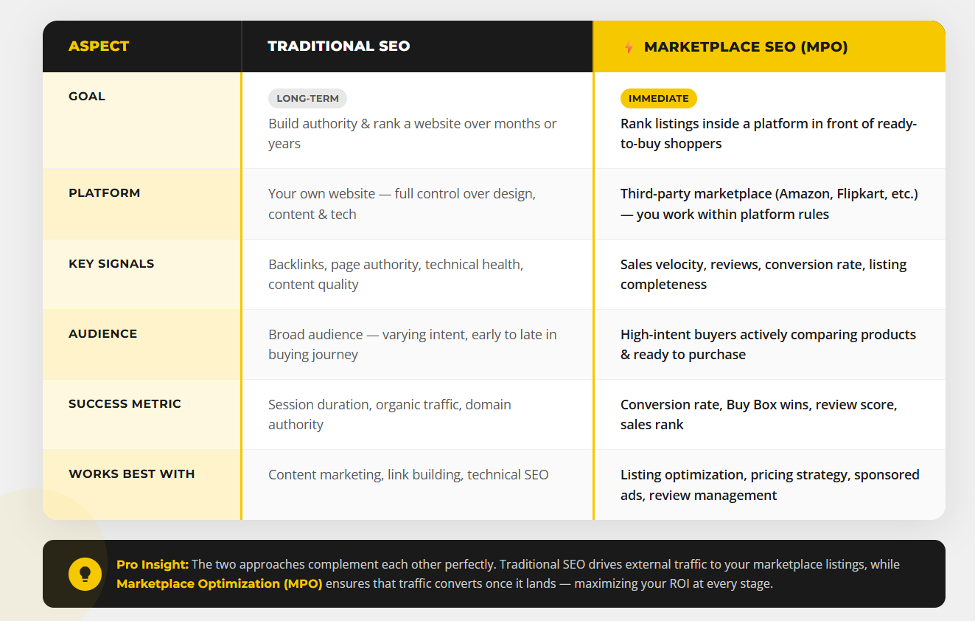
Traditional SEO is about building long-term authority for a website. You create content, earn backlinks, and fix technical issues, and over months or years, your site climbs the search rankings. The traffic you earn arrives on a website you control.
Marketplace SEO works inside a platform you do not own, in front of buyers who are already comparing products and ready to purchase. The signals the algorithm responds to are different. Sales velocity matters more than backlinks. Reviews matter more than page authority.
Conversion rate matters more than session duration. The two approaches complement each other well. Traditional SEO can drive external traffic into your marketplace listings, while Marketplace Optimization (MPO) ensures that traffic converts once it lands.
Major Marketplaces That Need MPO
Amazon Marketplace Optimization
Amazon’s ranking system has evolved over time from A9 to A10 and considers a mix of factors such as keyword relevance, sales velocity, conversion rate, and customer satisfaction metrics. There is no one overriding factor. They must all perform in a consistent manner in order to be ranked and remain ranked.
Here’s why the Buy Box is a central factor for Amazon success since most purchases are made via the Buy Box, this feature is essential for the success of the company. To win, it’s all about competitive pricing and reliable fulfilment where possible, with high seller metrics on returns, response time and cancellation rate.
Sponsored ads can help new listings get some visibility while they’re working on their organic ranking, but the best time to use sponsored ads is if the listing is already well optimized.
Walmart Marketplace Optimization
The Walmart marketplace has expanded rapidly and now provides a viable new distribution channel for brands that are focused on selling on Amazon. Competitive pricing is not the only factor to take into account when converting on Walmart.
Many Walmart sellers don’t realize that product feed quality is very important. Correct attributes, product data that is not cluttered and also detailed specifications helps the system match your listing with the appropriate searches. Performance of shipping is monitored. Fast delivery time and low cancellation rates will result in improved visibility over time with sellers.
Flipkart Marketplace Optimization
Flipkart dominates the ecommerce space in India, and focuses mainly on mobile-first, price-sensitive consumers. Prices that are competitive, with quick and reliable delivery options via Flipkart’s network consistently score higher on the list.
Flipkart is an under-exploited region-based targeting platform. The preferences and price sensitivity of consumers are very different across India. Its knowledge of what products will sell best in different marketplaces, and applying that knowledge to your pricing and listing choices, can make a significant difference for you when you play this game.
Etsy Marketplace Optimization
Etsy buyers are not in the same mindset as Amazon buyers. They’re seeking items that are personal, original, or homemade; they may be willing to pay more for it. Your listing has to communicate that. These things matter on Etsy, they don’t matter on other platforms.
Tags are a critical part of Etsy’s search engine. Fill in all the tag slots and select terms that your target buyer is likely to actually search for, rather than category terms that all of your competitors are using.
eBay Marketplace Optimization
In addition to having listings with set prices, eBay also provides auctions. Unlike other marketplaces, eBay offers both fixed price and auction listings. It uses a Cassini search algorithm that places a high value on product details, as well as the attribute fields provided for each category.
The timing makes a difference with auction listings. Listings that close during any busy shopping periods on weekdays tend to get more bids and are sold for more money. Seller ratings are front and center on eBay and they play a key role in building buyer’s confidence.
Future Trends in Marketplace Optimization
With the help of AI-optimization tools, what can be achieved at scale is undergoing a transformation. Previously, it could take hours to manually analyze, scan competitor listings, identify keywords gaps, and monitor pricing changes, but now that can all be done in minutes.
Voice search is transforming the way buyers are engaging marketplaces on mobile. Users are increasingly searching longer phrases and natural language keywords instead of short generic statements or phrases.
Visual search is gaining traction in parallel. Buyers are using images to find similar products rather than typing descriptions into a search bar. Listings with high-quality, detail-rich images are better positioned as this behavior grows.
Predictive analytics is allowing sellers to anticipate demand shifts before they happen rather than responding to them weeks later. And retail media, the paid advertising ecosystem that sits inside marketplaces, is one of the fastest-growing channels in digital marketing. If you’re also planning to get started with MPO, contact EZ Rankings- best digital marketing agency.
Frequently Asked Questions
How does Marketplace Optimization improve sales?
MPO improves sales by addressing both parts of the problem. First, it makes your product easier to find by pushing it higher in marketplace search results. Second, it makes your listing better at converting buyers once they click. Better titles, stronger images, and clearer descriptions all contribute to higher conversion rates. The two effects reinforce each other because marketplace algorithms treat conversion rate as a ranking signal.
What marketplaces can be optimized?
Any marketplace that lets sellers customize their listings can benefit from MPO. The most commonly worked platforms are Amazon, Walmart, Flipkart, eBay, and Etsy, but the same underlying principles apply to Meesho, Myntra, Noon, Lazada, and regional platforms across Southeast Asia, the Middle East, and Europe. Each platform has its own algorithm and its own ranking logic, so the specific tactics need adjusting for each one.
How long does MPO take to show results?
Some changes show results quickly. Improved images and a clearer title can lift conversion rates within days simply because the listing is doing a better job. Ranking improvements take longer, typically two to six weeks as the algorithm registers the listing changes and the resulting shift in conversion or sales performance. A comprehensive Marketplace Optimization (MPO) overhaul often takes two to three months to fully stabilize in terms of ranking.
Why are product reviews important in MPO?
Reviews serve two functions simultaneously. For the algorithm, review volume and rating score are direct ranking signals. A product with hundreds of strong reviews will almost always outrank a comparable product with twenty, assuming other listing factors are similar. For the buyer, reviews reduce the perceived risk of purchasing from a brand they do not know. Detailed, genuine reviews from real customers make a product far less of a gamble.
Does MPO include marketplace advertising?
The role of MPO and marketplace advertising is different. MPO prioritizes ranking and listing quality for organic traffic, rather than paid traffic. This paid visibility is accomplished through marketplace advertising, such as Amazon Sponsored Products, Walmart Connect or other platforms available. They complement each other. A well-optimized listing will convert the paid traffic more efficiently, which means less cost per sale. If sales are driven by strong ads, it can also impact the organic ranking over time.
What factors affect product rankings on marketplaces?
A typical collection of signals is used by most of the major marketplaces, though the weight given to each of those signals is different. A relevant title, description, and backend signals the algorithm what your product entails and which searches it should be seen in. When learning to forecast sales velocity, the algorithms consider it a quality indicator because they indicate that buyers are actively selecting your product. The volume and average rating are indicators of post purchase satisfaction.
How often should marketplace listings be updated?
A good starting point is once a month. This means analysing the effectiveness of keywords, monitoring conversion rate fluctuations and benchmarking against your competitors’ listings, which may have updated their listings during that time. When you make major changes to the content, like new photos, copy changes, or a new keyword approach, you will need to do it every 3-6 months, depending on the market changes. It’s crucial to pay special attention to seasonal products before their peak season to ensure that they are getting the appropriate search terms at the right time.

Mansi Rana
TEDx speaker and digital marketing expert with 22 years of experience driving business growth through innovation and strategy. Known for leadership rooted in both IQ and EQ, with a focus on ethical marketing and collaboration.
LinkedIn